
Metal privacy screens can help create more comfortable outdoor spaces by limiting certain views, filtering sunlight, and defining areas within a property. However, their effectiveness depends on the opening pattern, screen position, viewing angle, and supporting structure.
This guide explains how different designs affect privacy, airflow, and shade, helping homeowners, architects, and contractors in Saudi Arabia compare options and prepare suitable specifications for their projects.
Planning an outdoor boundary? Contact Arab Fences to explore available metal fencing systems and discuss your project requirements.
Metal Privacy Screens: What Do They Actually Do?
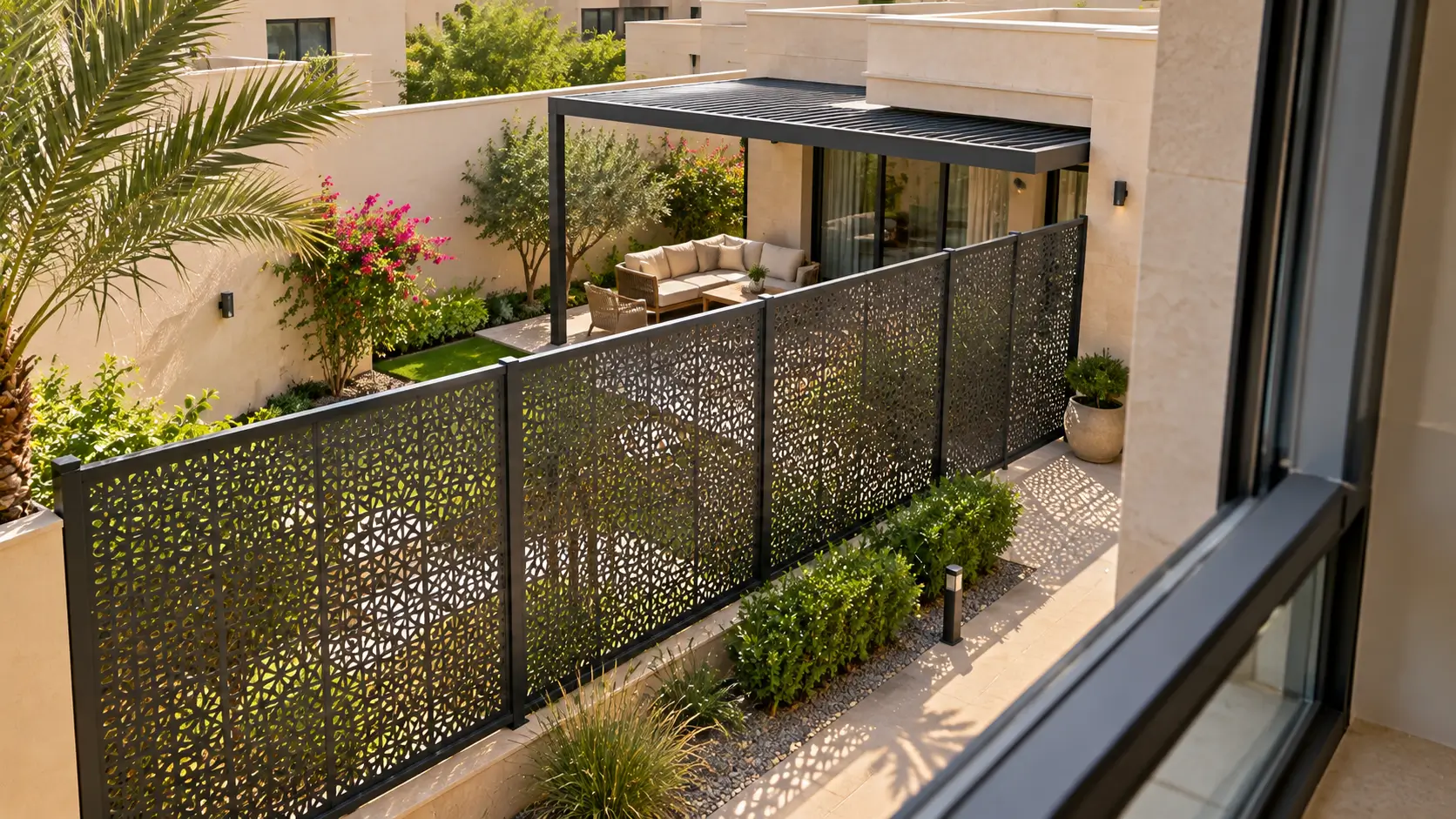
Metal privacy screens are architectural barriers designed to reduce visibility into or across selected spaces. They can be used around gardens, terraces, courtyards, outdoor seating areas, and other parts of a property where visual separation is important.
Unlike a conventional fence that primarily defines a boundary, a privacy screen is usually designed to address a particular viewing direction or screening requirement.
For example, a homeowner may want to reduce visibility from a neighbouring window while maintaining some natural light and airflow. The suitable design depends on where the observer is located, the space being screened, and the level of privacy required.
Creating Visual Separation
A metal screen can help separate a patio from a driveway or reduce direct views between neighbouring outdoor areas.
However, an open decorative pattern should not be described as providing complete privacy unless the installed configuration has been assessed for that purpose.
Filtering Sunlight
Some metal screen designs can intercept direct sunlight and create patterned shadows on nearby surfaces.
The resulting shade depends on the screen orientation, opening pattern, and position of the sun throughout the day.
Defining Outdoor Spaces
Privacy screens may help organize outdoor seating areas, pathways, and courtyards without requiring a fully enclosed wall.
Improving Architectural Appearance
Metal screens can introduce clean lines, geometric patterns, and selected colours into a contemporary outdoor design.
The appearance should be coordinated with the surrounding building, fence, gates, and landscape.
How Much Privacy Can a Metal Screen Provide?
The level of privacy depends on more than the amount of solid metal in a screen.
Even a relatively dense perforated panel may allow visibility from certain distances and angles. The actual screening effect should therefore be evaluated from the positions where people are most likely to look through it.
Viewing Distance
The distance between the observer and the screen affects how the opening pattern appears.
Small holes can become less visually prominent from a distance, but that does not necessarily mean the space behind them becomes impossible to see.
Viewing Angle
A screen positioned to interrupt direct horizontal views may provide less screening from elevated windows or balconies.
For properties surrounded by multi-storey buildings, important sightlines should be considered before selecting the screen height and pattern.
Screen Height and Position
A screen positioned close to the area being protected may interrupt particular sightlines differently from one installed along a distant boundary.
The required height depends on the location of the observer and the part of the property requiring privacy.
Day and Night Visibility
Lighting conditions can significantly affect the perceived screening effect.
An outdoor seating area that appears relatively private during daylight may become more visible from a darker neighbouring property when illuminated at night.
When Greater Privacy Is Required
If the project requires substantial visual screening, an open perforated panel may not be sufficient.
Solid panels, suitably oriented slats, or another specifically designed arrangement may be more appropriate, subject to structural requirements and product availability.
Need a suitable outdoor boundary? Discuss the documented metal fencing options available from Arab Fences.
Privacy and Perforation Ratio Explained
The perforation ratio, also known as the open area ratio, describes the percentage of a panel’s surface occupied by openings.
It is an important specification for perforated metal screens because it affects the amount of solid material and the available paths for light and air.
However, open area percentage alone cannot establish privacy, ventilation performance, or the amount of shade a screen will provide in every situation.
What Does Open Area Percentage Mean?
A panel with 30% open area has openings occupying approximately 30% of its measured surface, with the remaining area formed by solid material.
This is a geometric measurement rather than a guaranteed privacy rating.
Hole Size and Spacing
Two panels can have the same open area percentage while using different hole sizes and spacing patterns.
For example, one panel may contain many small perforations, while another uses fewer large openings.
Both can have similar open area percentages but produce different appearances and sightlines.
Hole Shape and Pattern
Round, square, rectangular, and irregular openings can create different visual effects.
The arrangement and orientation of those openings may also influence the directions from which people can see through a panel.
Why Testing the Actual View Matters
Where privacy is a priority, review the proposed pattern at a realistic distance and viewing angle.
A physical sample, technical drawing, or representative mock-up can help identify whether the design meets the intended visual requirement.
Open Area and Privacy Comparison
| Screen Characteristic | Potential Effect | Important Limitation |
|---|---|---|
| Lower open area | More solid appearance and less direct passage through openings | Does not guarantee privacy from every angle |
| Higher open area | More potential for light and air passage | May allow greater visibility |
| Small perforations | Finer visual pattern | Distance and lighting still influence visibility |
| Large perforations | More visible individual openings | May not suit privacy-focused spaces |
| Angled slats | Can interrupt selected sightlines | Effect depends on orientation |
| Solid panel | Blocks direct views through the panel material | Requires appropriate structural design |
For additional technical information about perforation patterns and open area percentages, see the F.H. Brundle guide to perforated metal mesh.
Screen Position, Sun Direction and Shade
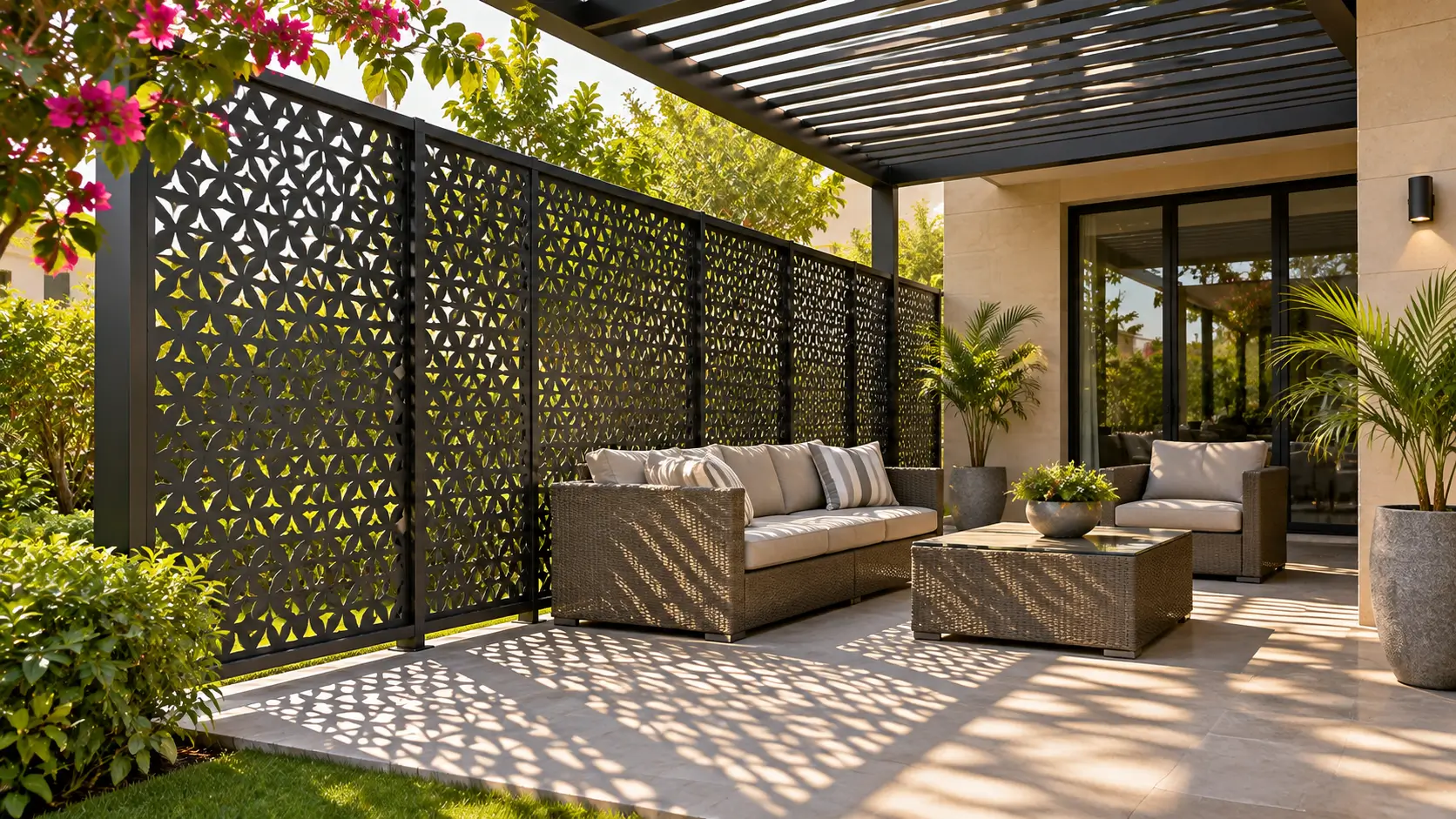
The shading effect of outdoor metal privacy screens depends on the relationship between the screen and the sun.
A decorative pattern may produce attractive shadows without necessarily providing consistent shade throughout the day.
Morning and Afternoon Sun
The direction and angle of sunlight change over time.
A screen that shades a seating area in the morning may allow more sunlight through during the afternoon.
The design should therefore consider when the shaded space will be used.
Low-Angle Sunlight
Low-angle sunlight may pass through openings that appear more effective when the sun is higher in the sky.
This can be important when the objective is to reduce glare from a particular direction.
Distance from the Area Being Shaded
The distance between a screen and the surface behind it influences where shadows fall.
A screen positioned away from the intended seating area may not provide shade where it is required.
Decorative Shade vs. Functional Shade
Patterned shadows can improve the appearance of an outdoor space, but they should not be confused with a verified shading performance.
If shade is a major project requirement, the proposed screen should be evaluated against the relevant sun positions and site geometry.
Can Privacy Screens Reduce Electricity Costs?
External shading can influence solar exposure, but lower electricity consumption cannot be guaranteed simply because a metal screen has been installed.
Actual results depend on the building, surrounding conditions, glazing, screen location, and other factors.
Any specific energy-saving claim requires appropriate project evidence.
Airflow and Ventilation Through Metal Screens
Airflow is another important factor when choosing a privacy screen for an outdoor area.
Openings can allow air to pass through a panel, but actual airflow depends on the design and environmental conditions.
Open Area and Air Movement
A relatively open screen may present less obstruction to air movement than a solid panel under comparable conditions.
However, wind direction, pressure differences, surrounding structures, and opening geometry also influence the result.
Perforated Screens
Perforated screens can provide a combination of partial visual screening and air passage.
Hole size, spacing, and pattern should be considered together when comparing options.
Slatted Screens
Horizontal, vertical, and angled slats allow air to pass between their members.
The spacing and orientation of the slats also influence visibility through the screen.
Solid Panels
Solid metal panels do not allow direct airflow through the panel material.
Where ventilation is important, the surrounding layout must provide an appropriate alternative airflow path.
Avoiding Unsupported Ventilation Claims
The presence of openings does not establish a specific ventilation rate or guarantee adequate natural ventilation.
Projects with defined ventilation requirements may need a separate technical assessment.
Types of Outdoor Metal Privacy Screens
Several types of metal privacy screens are used in residential and commercial architecture.
The following categories describe general design options. Their inclusion does not mean that Arab Fences currently manufactures every listed screen type.
Perforated Metal Screen Panels
Perforated panels use a repeated arrangement of holes or openings in a metal sheet.
They can create decorative screening and filtered light, depending on the selected pattern.
The panel thickness, open area, supporting frame, and protective finish must suit the intended application.
Horizontal Metal Slat Screens
Horizontal slats create a contemporary appearance and can reduce direct views when correctly spaced and positioned.
Closer spacing may increase screening while also affecting airflow and wind loading.
Vertical Metal Slat Screens
Vertical members produce a different architectural effect and may interrupt selected viewing directions.
Actual privacy depends on spacing, orientation, height, and the observer’s position.
Angled Louver Screens
Louvered screens use angled members to influence sightlines and the passage of light and air.
Their effectiveness depends on the exact angle and installed orientation.
Solid Metal Privacy Panels
Solid panels can provide greater visual separation through the panel itself.
However, their surface area can create different wind loads from those associated with open mesh screens.
Supporting posts, connections, and foundations must suit the actual design.
Decorative Laser-Cut Screens
Laser-cut screens can feature geometric or artistic openings that create distinctive visual patterns.
The suitability of a design depends on its material, thickness, geometry, supporting structure, and intended use.
Custom laser-cut screen production is not confirmed within the Arab Fences product information reviewed for this article.
Choosing Metal Privacy Screens for Villas and Gardens
Outdoor areas within the same property can require different levels of privacy and openness.
A screen that suits a courtyard may not be appropriate for a front garden or an elevated balcony.
Villa Courtyards
A courtyard may need screening from neighbouring windows or adjacent properties.
The design should consider the specific direction from which views need to be interrupted.
Garden Seating Areas
Outdoor seating areas often benefit from balancing visual screening with natural airflow.
Consider seated eye level, surrounding buildings, and nearby pathways.
Terraces and Balconies
Elevated spaces can create more complex viewing angles and may be exposed to different wind conditions.
The supporting structure and applicable local requirements should be reviewed before selecting a screen.
Side Boundaries
Some properties need screening only along a particular side boundary.
Providing privacy in targeted locations may preserve greater openness elsewhere.
Front Gardens
Front gardens may prioritize visibility and landscaping rather than visual privacy.
Where an open boundary is acceptable, conventional metal fencing may be more appropriate than a dedicated privacy screen.
For related design ideas, explore Garden and Fence Solutions for Beauty and Privacy.
Planning a villa or garden boundary? Contact Arab Fences to explore available metal fencing configurations.
Metal Screen Materials, Fixings and Finishes
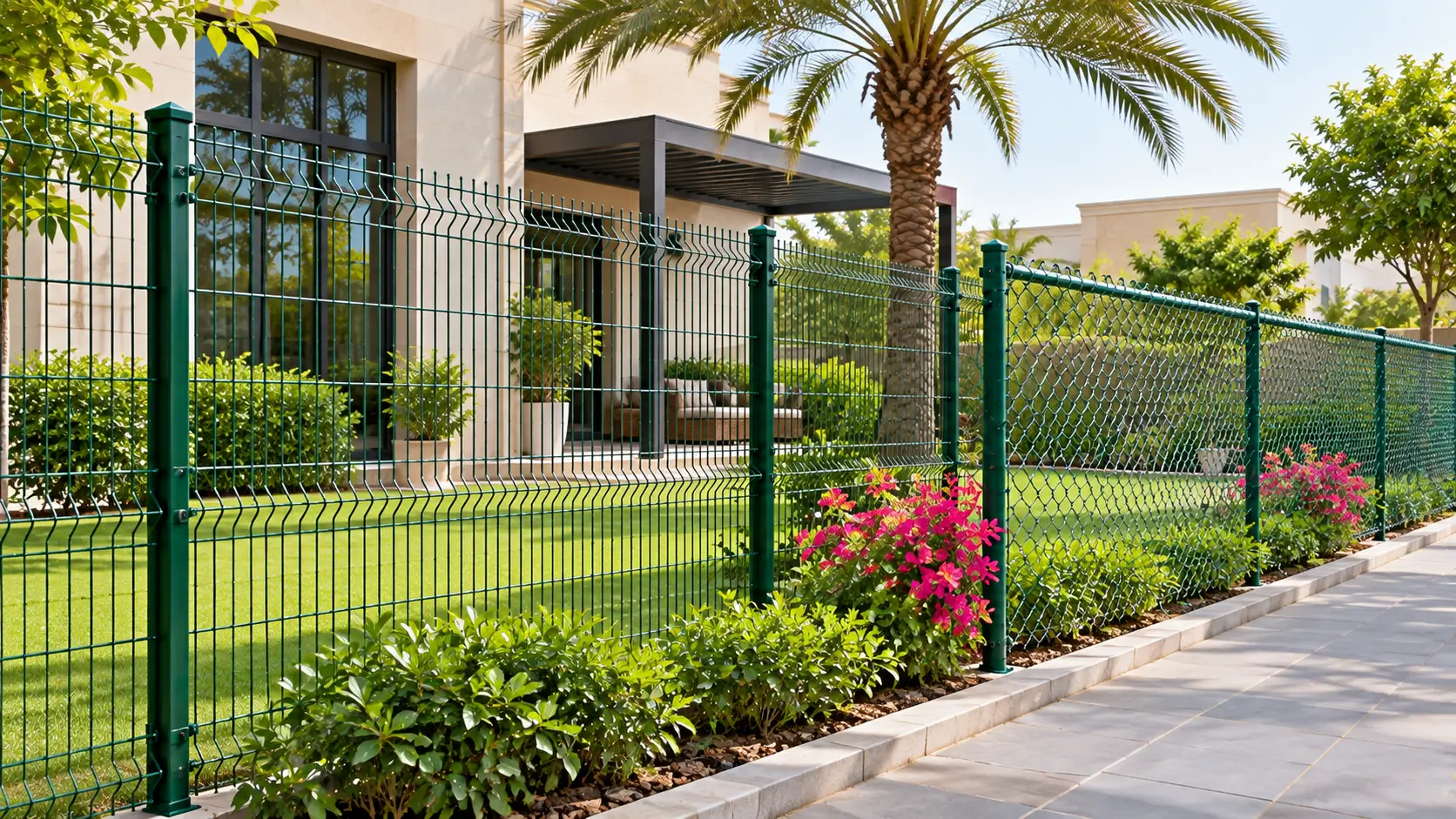
The performance of an outdoor metal screen depends on its material and supporting system as well as its appearance.
Material selection, structural connections, and corrosion protection should suit the actual site conditions.
Steel Privacy Screens
Steel can be used in certain architectural screening systems.
Its suitability depends on the grade, thickness, section dimensions, and structural design.
Carbon steel used outdoors requires appropriate corrosion protection.
Aluminum Privacy Screens
Aluminum is used in some architectural screening products because of its relatively low weight and corrosion characteristics.
However, actual performance depends on the selected alloy, section dimensions, connections, and supporting structure.
A dedicated aluminum privacy screen range has not been confirmed within the reviewed Arab Fences catalogue.
Galvanized Steel Screens
Galvanizing applies a protective zinc coating to steel.
It can help reduce corrosion, but it does not make a product permanently immune to rust or deterioration.
The coating specification should suit the expected environmental exposure.
Powder-Coated Metal Screens
Powder coating can provide a coloured finish and form part of a specified protective system.
Its performance depends on the coating specification, preparation, and service conditions.
Posts and Supporting Frames
Screen panels need suitable frames or supporting posts.
The selected components must accommodate the screen dimensions, relevant loads, and connection requirements.
Anchors and Fixings
Brackets, anchors, fasteners, and base plates must be compatible with the supporting structure.
A privacy screen should not be fixed to an existing wall or slab without confirming the suitability of the structure and anchorage.
Maintenance Requirements
Outdoor metal components should be inspected for coating damage, loose connections, and other signs of deterioration.
Maintenance requirements depend on the selected material, finish, and exposure conditions.
Metal Privacy Screens vs. Open Mesh Fencing
Metal privacy screens and conventional mesh fences may look similar in some applications, but they do not necessarily perform the same function.
A privacy screen is generally selected to interrupt particular views, while open mesh fencing primarily defines a boundary and maintains visibility.
3D Welded Mesh Fencing
Arab Fences manufactures a 3D Welded Mesh Fencing System in Saudi Arabia.
The system uses rigid welded steel panels with formed bends and includes different dimensions and finish options.
Its published wire diameter range is 3–6 mm.
3D welded mesh may be suitable for residential boundaries where an open-view fence is acceptable.
It should not be described as a solid visual privacy screen.
Chain Link Fencing
Arab Fences also manufactures Chain Link Fencing using interwoven steel wires.
The published range includes wire diameters from 2 mm to 5.9 mm, mesh openings from 40 × 40 mm to 80 × 80 mm, and standard fabric heights from 0.5 m to 4 m.
Chain link provides an open woven boundary and generally allows views through the fence.
Privacy Screen and Metal Fence Comparison
| System | Main Purpose | Privacy | Arab Fences Availability |
|---|---|---|---|
| Solid metal screen | Visual screening | Can obstruct direct views through the panel | Dedicated product not confirmed |
| Perforated metal screen | Partial screening and architectural design | Depends on pattern and viewing angle | Custom screen production not confirmed |
| Slatted metal screen | Directional visual screening | Depends on spacing and orientation | Custom screen production not confirmed |
| 3D welded mesh fence | Boundary definition | Generally low visual privacy | Published product |
| Chain link fence | Boundary definition | Generally low visual privacy | Published product |
Where privacy is a priority, open mesh fencing should not automatically be treated as equivalent to a purpose-designed screening system.
For additional boundary design ideas, read Modern Metal Fence Design for Your Outdoor Space.
Need to compare available fencing systems? Request technical product information from Arab Fences.
Common Metal Privacy Screen Design Mistakes
Assuming Perforations Guarantee Privacy
Even small openings can allow views through a screen. Actual sightlines and lighting conditions should be considered.
Ignoring Night-Time Visibility
An illuminated space can become more visible through a screen when viewed from a darker area.
Choosing a Pattern Without Considering Airflow
Dense patterns may restrict air movement. Defined ventilation requirements may need technical evaluation.
Expecting Constant Shade
Shade changes with the sun’s position and the installed screen orientation.
Overlooking Wind Loads
Solid and partially open panels can impose different loads on their supporting structures.
Using an Unsuitable Protective Finish
The selected material and coating should suit the expected environmental conditions.
Ignoring the Supporting Structure
Panels, frames, anchors, and foundations must be compatible with the actual installation.
Assuming Every Custom Design Is Available
A reference photograph does not confirm that a specific supplier manufactures the same screen.
What Affects Metal Privacy Screen Costs?
The cost of metal privacy screens depends on the design, materials, dimensions, protective finish, and supporting components.
Different screen configurations should not be compared using price alone.
Material and Thickness
Steel and aluminum products involve different material characteristics and fabrication requirements.
Pattern Complexity
Simple perforations and elaborate decorative designs may require different manufacturing processes.
Panel Dimensions
Panel height, width, and quantity influence material requirements and supporting arrangements.
Protective Finishes
Galvanizing, coating systems, and colour specifications can affect the complete product requirements.
Supporting Components
Frames, posts, foundations, brackets, and anchors should be included when evaluating the project scope.
Site Conditions
Existing walls, ground levels, wind exposure, and access conditions may influence the design.
Customisation Costs
Special patterns, finishes, and fabrication requirements should not be assumed to be available without additional cost.
Any custom design must be confirmed in the supplier’s quotation.
Have project drawings or a design reference? Contact Arab Fences to discuss available products and quotation requirements.
Metal Privacy Screen Selection Checklist
Before contacting a supplier, prepare the information needed to identify an appropriate screening or fencing solution.
| Requirement | Information to Provide |
|---|---|
| Project Location | City and site in Saudi Arabia |
| Property Type | Villa, garden, terrace, courtyard, or other application |
| Primary Goal | Privacy, shade, decoration, or boundary definition |
| Screening Area | Required location and dimensions |
| Viewing Direction | Neighbouring windows, streets, or other sightlines |
| Privacy Requirement | Partial screening or greater visual separation |
| Sun Exposure | Direction and time when shade is needed |
| Airflow Requirement | Desired openness and ventilation considerations |
| Preferred Design | Perforated, slatted, solid, or open mesh system |
| Material | Specified steel, aluminum, or other material |
| Open Area | Required percentage where applicable |
| Protective Finish | Galvanized or specified coating |
| Supporting Structure | Existing walls, posts, foundations, and connections |
| Technical Documents | Drawings, photographs, or project specifications |
| Commercial Scope | Products and any separately requested services |
Step 1: Identify the View to Be Blocked
Start by identifying the observer’s likely position and the part of the property requiring screening.
Step 2: Define the Privacy Level
Decide whether partial screening is sufficient or whether greater visual separation is required.
Step 3: Consider Sunlight and Airflow
Record the relevant sun direction, desired shade period, and any ventilation requirements.
Step 4: Confirm the Supporting Structure
Identify the proposed mounting location and any available structural information.
Step 5: Verify Product Availability
Ask whether the preferred design is part of the supplier’s available range or requires separate confirmation.
Step 6: Request Complete Specifications
A useful quotation should identify the material, dimensions, protective finish, compatible components, and agreed commercial scope.
Metal Fencing Options from Arab Fences
Arab Fences manufactures metal fencing systems locally in Saudi Arabia.
Its documented product range includes systems that may suit outdoor properties where an open boundary is acceptable.
3D Welded Mesh Fencing
The company’s 3D welded mesh range includes rigid steel panels, hollow structural posts, compatible accessories, and different protective finishes.
It can create a geometric metal boundary for suitable residential and commercial applications.
Chain Link Fencing
Arab Fences manufactures chain link fencing with different wire diameters, mesh openings, heights, and protective treatments.
The open woven construction can suit gardens and other boundaries where maintaining visibility is desirable.
Protective Finish Options
The manufacturer publishes galvanized and selected coated options for its metal fencing systems.
Black RAL 9005 and green RAL 6005 are listed for relevant products, with other colours potentially available on request.
Are Custom Metal Privacy Screens Available?
A dedicated range of perforated, laser-cut, or slatted metal privacy screens has not been independently confirmed within the reviewed Arab Fences product information.
Customers interested in those designs should contact the company to clarify whether a suitable product or alternative is available.
What Information Should You Send?
Provide your project location, required dimensions, intended screening objective, preferred finish, and any available drawings or reference photographs.
This helps the company identify relevant documented fencing options and clarify the available scope.
Contact Arab Fences for Outdoor Metal Fencing Specifications and a Project Quotation.
Frequently Asked Questions About Metal Privacy Screens
1. What Are Metal Privacy Screens Used For?
Metal privacy screens are used to limit selected views, separate outdoor areas, and provide architectural screening. Some designs can also filter sunlight, depending on their position and configuration.
2. Do Perforated Metal Screens Provide Complete Privacy?
Not necessarily. The screening effect depends on the opening pattern, viewing angle, distance, and lighting conditions. Perforations may still allow people to see through the panel.
3. What Is the Open Area Ratio of a Privacy Screen?
It is the percentage of a panel’s measured surface occupied by openings. This describes the geometry but does not independently determine privacy or ventilation performance.
4. How Do Metal Privacy Screens Affect Airflow?
Openings and gaps can allow air to pass through a screen. Actual airflow depends on the pattern, wind conditions, orientation, and surrounding structures.
5. Can a Metal Screen Reduce Direct Sunlight?
Yes. Some configurations can intercept direct sunlight and create shade. Results depend on screen position, orientation, opening pattern, and the sun’s location.
6. What Is the Best Metal Privacy Screen for a Garden?
The appropriate design depends on the required privacy, desired airflow, appearance, and site conditions. Greater screening may require a more closed arrangement than an ordinary open metal fence.
7. Are Galvanized Metal Privacy Screens Rustproof?
No. Galvanizing provides corrosion protection, but it does not make steel permanently immune to rust. Performance depends on coating quality, condition, and environmental exposure.
8. How Should Outdoor Metal Privacy Screens Be Fixed?
Fixings and supporting components should be selected for the screen dimensions, applied loads, and supporting structure. Exposed installations may need particular structural consideration.
9. What Affects the Cost of Metal Privacy Screens?
Costs depend on material, dimensions, pattern complexity, protective finish, frames, posts, fixings, site conditions, and the agreed supplier scope.
10. Does Arab Fences Manufacture Custom Metal Privacy Screens?
Arab Fences publishes 3D welded mesh and chain link fencing systems. A dedicated custom privacy screen range has not been confirmed, so customers should contact the company to clarify availability.
Choose the Right Outdoor Boundary with Arab Fences
Selecting metal privacy screens requires careful consideration of sightlines, opening patterns, sunlight, airflow, materials, and supporting structures.
A decorative screen may not provide the expected privacy or shade unless its design suits the actual location and intended purpose.
For projects where an open metal boundary is suitable, Arab Fences manufactures documented 3D welded mesh and chain link fencing systems in Saudi Arabia.
Request Metal Fencing Specifications and a Project Quotation from Arab Fences and share your location, dimensions, intended application, and preferred design.