
Temporary Fence in Saudi Arabia | Panels & Specifications
Temporary fence panels provide a practical solution for securing construction sites, defining restricted areas, and organizing temporary perimeters across Saudi Arabia. Whether you are managing a building project, preparing an event venue, or separating an equipment storage area, selecting the right fencing system helps improve site organization and access control.
Arab Fences offers locally manufactured galvanized steel fencing panels with different mesh configurations, movable bases, connecting clamps, bracing components, and matching gates. Explore the specifications, applications, and purchasing considerations below to identify a suitable solution and request a quotation for your project.
Temporary Fence Solutions for Construction Sites and Events
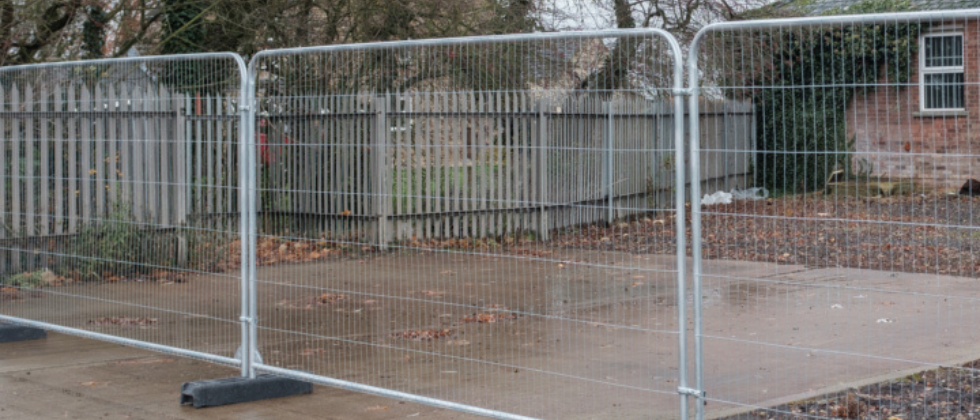
A temporary fence is a movable perimeter system used to define site boundaries, restrict access, and separate operational areas without installing a conventional permanent fence foundation.
Unlike fixed fencing, portable panels can be relocated when project layouts change. This makes them useful for construction projects, events, maintenance areas, and other locations where perimeter requirements may evolve.
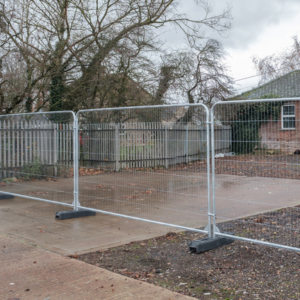
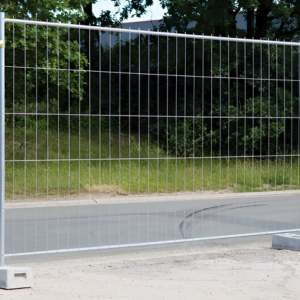
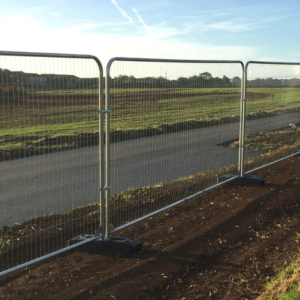
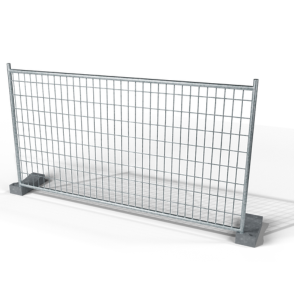
The temporary fencing products described by Arab Fences use galvanized steel pipe frames and welded wire mesh panels. Individual sections are connected using clamps and supported by removable concrete or rubber bases.
Depending on the required configuration, the system may also include brace pipes and matching access gates.
Key Benefits of Portable Fencing
Flexible site boundaries: Panels can be repositioned as work areas change.
Access management: Matching gates help define entry and exit points.
Clear perimeter separation: Welded mesh panels distinguish restricted zones from surrounding areas.
Reusable components: Panels and accessories can be relocated when they remain in suitable condition.
Visibility through the fence: Mesh infill allows visual monitoring of the enclosed area.
Multiple configurations: Frame dimensions, mesh openings, and accessories can be selected according to project specifications.
The final configuration should always reflect the site’s operating conditions, access requirements, and approved safety arrangements.
Need fencing panels for a construction project or temporary site? Contact Arab Fences to discuss the available specifications and request a quotation.
Temporary Fence Specifications and Available Components
Selecting a suitable fencing system requires reviewing the panel dimensions, steel frame, mesh configuration, support bases, and connecting accessories.
Arab Fences publishes technical details for its locally manufactured temporary fencing products, helping contractors and purchasing teams prepare clearer material requirements.
Galvanized Steel Frames and Panel Dimensions
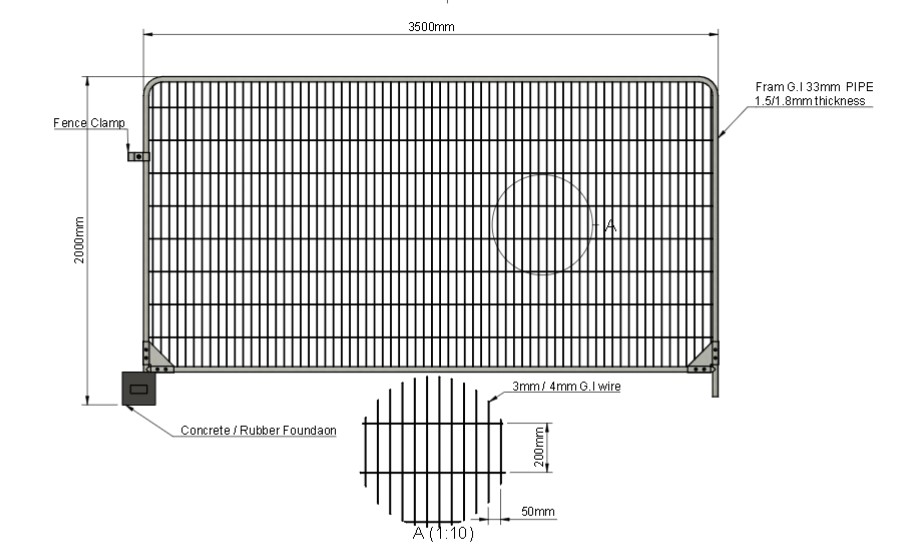
The standard temporary fencing panel listed by Arab Fences measures 2 meters in height and 3.5 meters in width.
The frame is manufactured using galvanized steel pipes with a published diameter of 33 mm.
Available pipe wall thicknesses include:
1.5 mm
1.8 mm
These specifications provide a starting point for preparing project quantities and comparing supplier quotations.
Alternative dimensions should be discussed with the supplier when the project requires a different panel configuration.
Welded Wire Mesh Specifications
The panels use galvanized welded wire mesh attached to the surrounding steel frame.
Arab Fences lists three wire diameter options:
3 mm
4 mm
5 mm
Published mesh opening options include:
50 × 100 mm
50 × 200 mm
100 × 200 mm
The appropriate configuration depends on the intended application and the technical requirements specified by the project.
A smaller mesh opening creates a denser infill, while different wire diameters affect the material configuration.
However, wire thickness and mesh opening should not be treated as independent indicators of certified security performance.
Technical Specifications Table
| Component | Published Specification | Purchasing Consideration |
|---|---|---|
| Standard panel height | 2,000 mm | Confirm required perimeter height |
| Standard panel width | 3,500 mm | Calculate quantities using the installed layout |
| Frame pipe diameter | 33 mm | Check compatibility with connectors |
| Frame wall thickness | 1.5 mm or 1.8 mm | Select according to project requirements |
| Mesh wire diameter | 3, 4, or 5 mm | Confirm the required wire specification |
| Mesh opening | 50×100, 50×200, or 100×200 mm | Match the required mesh configuration |
| Panel supports | Concrete or rubber bases | Assess ground conditions and stability |
| Connections | Clamps | Confirm the connection arrangement |
| Additional support | Brace pipes | Evaluate wind exposure and attached materials |
| Access gates | Single-leaf or double-leaf | Confirm gate dimensions and operation |
These are product specifications published by Arab Fences. They do not establish universal installation requirements or certified performance for every application.
Concrete and Rubber Fence Bases
Portable fencing panels are supported by removable bases rather than a continuous permanent foundation.
Arab Fences identifies concrete and rubber bases among the available supporting components.
The choice should consider:
Ground surface and level.
Panel dimensions and arrangement.
Exposure to wind.
Expected movement around the perimeter.
Additional bracing requirements.
Base weight alone does not guarantee stability. The complete fence arrangement must be evaluated for the conditions at the installation site.
Clamps and Additional Bracing
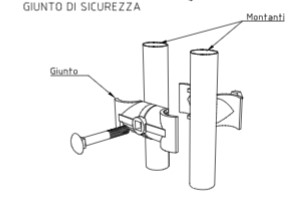
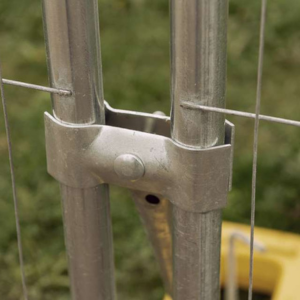
Connecting clamps join adjacent panels to form a continuous perimeter.
Brace pipes provide an additional support option where the site arrangement requires reinforcement.
Bracing becomes particularly important when fencing is installed in exposed areas or when banners and screening materials are attached to the mesh.
Solid coverings can increase wind loading significantly, even when the original fence panel has an open mesh design.
The required support arrangement should therefore be reviewed before installation.
Temporary Fence Gates
Access gates help organize the movement of workers, visitors, equipment, and vehicles.
Arab Fences describes several matching gate configurations, including:
Single-leaf gates.
Double-leaf gates.
Swinging gates.
Sliding gates.
Gate selection depends on the opening width, available space, and intended use.
Including gate locations in the initial perimeter drawing helps avoid unnecessary changes after the panels have been ordered.
Have a bill of quantities or technical drawing? Share your requirements with Arab Fences to receive a quotation covering the relevant panels and accessories.
Welded mesh infill:
The infill of Temporary fence is made of galvanized welded mesh wire. The welded mesh is welded on the edges of the frame through a spot-welding machine to avoid rust. Through ARAB METAL FENCES INDUSTRY’s advanced technology, the wire mesh is made locally with different options. The standard size of welded mesh is wire 3mm, 4mm, or 5mm with a mesh opening of 50x100mm, 50x200mm, or 100x200mm. Other options are available base on the customers’ needs.
Foundation
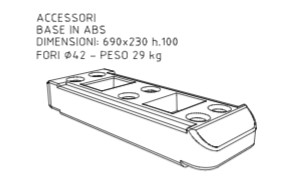
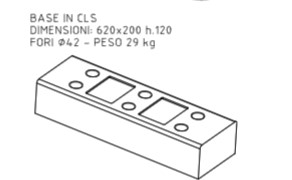
The heras fence panels are fixed on concrete or rubber foundation to prevent any movement. The foundations can easily be moved from one location to another by ejecting the panels from the foundations.
Clamps
Clamps For continuous fencing systems for long distances, clamps are required to connect two panels together at the center of the panel.
Brace Pipe
For high wind speed areas or if an advertisement banner is fixed on the panel, brace pipes are required to provide high stability of the panels. The brace pipes are made from the same panel structure and fixed on an additional concrete foundation.
Galvanizing Standards and Corrosion Protection
Temporary fencing is commonly exposed to outdoor conditions, making corrosion protection an important purchasing consideration.
Arab Fences describes its temporary fencing products as using galvanized steel frames and welded wire mesh.
Galvanizing provides a protective zinc coating that helps reduce corrosion of the underlying steel.
However, the appropriate galvanizing specification depends on the manufacturing process, product type, and project requirements.
What Should Buyers Check?
Before approving a fencing quotation, review:
The specified steel material.
The required galvanizing process.
The applicable coating standard.
Any coating thickness requirements.
Inspection or certification documents required by the project.
Site exposure conditions.
BS EN ISO 1461 is a recognized reference for hot-dip galvanized coatings applied to fabricated iron and steel articles.
It should not automatically be assumed that every galvanized fencing component complies with this standard unless the relevant product documentation confirms it.
For technical background, refer to the International Organization for Standardization and the applicable project specifications.
For projects with specific corrosion-protection requirements, request confirmation of the available coating specifications before placing an order.
Where Is Temporary Fencing Used in Saudi Arabia?
Temporary fencing is used in projects where a clearly defined perimeter is required for a limited period or where the layout may change during operations.
Arab Fences identifies several applications for its fencing products, including construction sites, events, equipment protection, commercial areas, residential developments, public facilities, and car parks.
Construction Sites
Construction projects often require clearly identified boundaries to separate active work zones from public areas.
Portable fencing can help contractors:
Define the project perimeter.
Organize site entrances.
Separate restricted work areas.
Adjust boundaries as construction progresses.
Identify areas used for equipment and materials.
The fencing should be integrated into the site’s wider access-control and safety arrangements.
Events and Temporary Venues
Temporary mesh panels can help establish venue boundaries and separate operational areas from visitor spaces.
Their modular design makes them useful when event layouts need to be adjusted.
Where the main objective is pedestrian queue management, a dedicated barrier may be more suitable.
Explore the company’s crowd control barrier solutions to compare the available product categories.
Equipment Storage Areas
Portable fencing can help define temporary equipment storage areas and distinguish them from surrounding operations.
The welded mesh design provides visibility through the perimeter.
However, the required security level should be assessed separately, particularly where valuable equipment or sensitive materials are involved.
Commercial and Residential Developments
Developers may use temporary fencing around areas undergoing construction, renovation, or maintenance.
The movable design allows site boundaries to change as work progresses.
For projects requiring a long-term perimeter, permanent fencing may offer a more suitable arrangement.
Car Parks and Public Facilities
Temporary panels can separate sections of car parks or public facilities during maintenance or redevelopment.
They should not be treated as vehicle-impact protection unless the specific system has been designed and approved for that purpose.
Planning a temporary work zone or project perimeter? Contact Arab Fences to discuss the available fencing configurations.
How Many Temporary Fence Panels Do You Need?
Calculating the approximate number of panels is an important step when preparing a quotation request.
Start by measuring the total length of the perimeter that requires fencing.
Then divide that length by the effective installed width of each panel.
Temporary Fence Panel Calculation
Number of panels = Total fence length ÷ Effective panel width
For example:
If your project requires a straight fencing line measuring 70 meters, and the effective installed width of each panel is 3.5 meters:
70 ÷ 3.5 = 20 panels
This provides an initial estimate for a straight section.
Factors That Affect the Final Quantity
The actual number of panels may change depending on:
Gate openings.
Corners and changes in direction.
Panel overlap or connection arrangements.
Uneven site boundaries.
Required access routes.
Special panel dimensions.
Project-specific installation details.
The number of bases, clamps, braces, and gates should also be calculated separately.
For complex layouts, a perimeter drawing or bill of quantities is preferable to relying on a simple length calculation.
Send your site perimeter dimensions to Arab Fences to help prepare a clearer material quotation.
How to Choose the Right Temporary Fence for Your Project
Choosing the right fencing system involves balancing perimeter requirements, panel specifications, site conditions, and access needs.
The following considerations can help contractors and purchasing teams prepare an accurate product request.
Define the Main Purpose
Start by identifying whether the fence will be used for:
Construction site separation.
Event perimeter management.
Equipment storage boundaries.
Temporary maintenance areas.
Commercial property development.
Restricted access zones.
The intended application helps determine which panel and accessory configuration should be considered.
Confirm the Required Height and Mesh
The standard panel height published by Arab Fences is 2 meters.
Projects requiring alternative heights or mesh configurations should identify those requirements before requesting a quotation.
Frame thickness, wire diameter, and mesh opening should be considered together.
Assess the Installation Environment
Ground conditions and wind exposure can influence the required support arrangement.
Long fence lines, exposed corners, and locations where banners are installed may require additional attention.
The project team should assess these conditions before approving the final configuration.
Plan Gates and Access Points
Identify pedestrian entrances, vehicle access points, and required emergency routes.
The selected gate configuration should provide the necessary opening without obstructing site operations.
Review the Complete Material List
A complete fencing request should identify the panels and relevant accessories.
This helps avoid comparing quotations that include different scopes of supply.
Need help organizing your fencing requirements? Prepare your layout, panel specifications, and access details before contacting Arab Fences.
Temporary Fence vs. Permanent Fence
Temporary and permanent fencing systems may both define boundaries, but they are designed for different operational requirements.
Temporary fencing is generally selected when the perimeter needs to be moved or removed.
Permanent fencing is typically intended for long-term boundary protection and uses a fixed installation arrangement.
| Feature | Temporary Fence | Permanent Fence |
|---|---|---|
| Primary purpose | Movable perimeter separation | Long-term boundary protection |
| Installation | Removable panels and bases | Fixed posts and foundations |
| Relocation | Designed for repositioning | Generally not intended for frequent relocation |
| Common applications | Construction sites and temporary events | Commercial, industrial, and property boundaries |
| Access arrangements | Matching portable gates | Permanent gate systems |
| Main purchasing consideration | Flexibility and site layout | Long-term performance and boundary requirements |
Neither option is automatically better for every project.
The appropriate choice depends on how long the perimeter is needed, the required security level, and the approved project design.
For a fixed boundary solution, explore the 3D welded mesh fencing system offered by Arab Fences.
Temporary Fence vs. Crowd Control Barriers
Temporary fencing and crowd control barriers are often used in similar environments, but their functions differ.
Temporary fencing generally establishes taller perimeter boundaries.
Crowd control barriers are primarily used to guide pedestrian movement and organize queues.
| Feature | Temporary Fence | Crowd Control Barrier |
|---|---|---|
| Main function | Perimeter separation | Pedestrian movement management |
| Typical structure | Tall welded mesh panels | Lower interlocking barrier sections |
| Common use | Construction and restricted areas | Events, queues, and public spaces |
| Access | Matching fence gates | Openings in the barrier arrangement |
| Main consideration | Perimeter layout and stability | Pedestrian management requirements |
The correct product should be selected according to its intended function.
A standard portable mesh fence should not be assumed to provide certified resistance to crowd pressure or vehicle impacts.
Compare the intended use and technical requirements before selecting a fencing or barrier system for your project.
Temporary Fence Installation and Stability Considerations
A well-planned fencing layout helps the panels remain correctly positioned throughout the project.
Although portable fencing is designed for relocation, its installation still requires attention to ground conditions, panel connections, and environmental exposure.
Inspect the Ground Surface
Check the fence line for uneven surfaces, slopes, obstructions, and areas where bases may not sit securely.
The support arrangement should be suitable for the actual installation conditions.
Position Panels and Bases
Arrange the bases according to the approved perimeter layout.
Position the panels while accounting for corners, access gates, and changes in direction.
Secure the Connections
Use the specified clamps to connect adjacent panels.
Check that the connections are correctly positioned and that the installed configuration matches the project requirements.
Review Wind Exposure and Bracing
Exposed locations and areas with attached banners may require additional support.
Bracing and foundation arrangements should be assessed according to the site conditions.
Inspect Gates and Access Routes
Verify that gates operate as intended and that required access routes remain clear.
Carry Out Periodic Inspections
During use, inspect the fencing for:
Displaced bases.
Loose clamps.
Damaged panels.
Unstable sections.
Obstructed gates.
Changes caused by wind or accidental impact.
Any damaged or unstable components should be addressed promptly.
For exposed or challenging sites, confirm the appropriate support arrangement before ordering fencing materials.
What Affects Temporary Fence Prices in Saudi Arabia?
Temporary fencing prices depend on the selected product specifications, order quantities, accessories, and delivery requirements.
Comparing only the price per panel may not reflect the total materials required to complete the perimeter.
Panel Dimensions and Steel Thickness
Frame dimensions, pipe thickness, wire diameter, and mesh configuration can influence the material requirements and quotation.
Bases and Connecting Accessories
Concrete bases, rubber bases, clamps, and brace pipes should be included in the material list where required.
Confirm whether the quotation includes these components.
Gates and Special Configurations
Single-leaf and double-leaf gates may affect the total cost.
Special dimensions or configurations should be identified before requesting pricing.
Order Quantity and Delivery Location
The total number of panels and accessories, together with the project location and delivery requirements, can influence the commercial offer.
Coating and Documentation Requirements
Projects requiring specific galvanizing standards, inspection documents, or technical certificates should identify these requirements during the quotation stage.
Request an itemized temporary fence quotation from Arab Fences to compare the full material scope rather than the panel price alone.
7 Reasons to Choose Arab Fences for Temporary Fencing
Selecting a fencing supplier is easier when the available products, specifications, and components are clearly documented.
Arab Fences offers several product features that support the purchasing process for temporary fencing projects in Saudi Arabia.
1. Local Manufacturing
Arab Fences identifies its temporary fencing panels as locally designed and manufactured in Saudi Arabia.
This provides customers with a local manufacturing source for their project inquiries.
2. Clearly Published Specifications
The product page includes panel dimensions, frame thicknesses, wire diameters, and mesh openings.
These details help purchasing teams prepare and compare technical requirements.
3. Multiple Mesh Configurations
The published range includes different wire diameters and mesh opening sizes.
This allows customers to identify the configuration required by their project specifications.
4. Galvanized Steel Construction
The product description identifies galvanized steel frames and welded mesh infill.
These materials are relevant to projects requiring corrosion-protected steel fencing components.
5. Removable Support Bases
Concrete and rubber bases are listed among the available components.
These support options are relevant to movable perimeter arrangements.
6. Connecting and Bracing Accessories
Arab Fences describes clamps and brace pipes as part of its temporary fencing components.
These accessories help customers prepare a more complete material list.
7. Matching Access Gates
The product range includes single-leaf and double-leaf gate configurations.
This allows project teams to consider access requirements alongside the perimeter panels.
The final product selection should always be confirmed against the project’s approved specifications and the supplier’s current availability.
Explore the available temporary fencing options and contact Arab Fences to discuss the requirements of your project.
Request a Temporary Fence Quote in Saudi Arabia
Preparing a detailed quotation request helps avoid missing components and makes supplier offers easier to compare.
Before contacting Arab Fences, provide the following information where available:
Project name and location.
Total perimeter length.
Required panel dimensions.
Preferred frame thickness.
Wire diameter and mesh opening.
Base type and quantity.
Number of connecting clamps.
Required bracing accessories.
Gate dimensions and configurations.
Project drawings or bill of quantities.
Expected delivery date.
If the project specifications are incomplete, provide the available information and identify the items requiring clarification.
The quotation should clearly state the included materials and any additional agreed scope.
You can explore the Arab Fences product range or submit your inquiry through the contact page.
Request a Temporary Fence Quote for Your Project in Saudi Arabia
Share your perimeter dimensions, technical specifications, and accessory requirements with Arab Fences to receive a quotation based on your project needs.
Temporary fencing is used to define movable boundaries around construction sites, event venues, equipment areas, maintenance zones, and other locations requiring temporary perimeter separation.
Arab Fences publishes a standard panel size of 2 meters high and 3.5 meters wide. Alternative dimensions should be confirmed directly with the supplier.
Divide the required fence length by the effective installed panel width and round up to the next whole panel. Adjust the estimate for gates, corners, and other layout requirements.
Arab Fences describes its temporary fencing panels as using galvanized steel frames and welded mesh. Specific coating requirements should be confirmed against the project's technical specifications.
The published product specifications list welded mesh wire diameters of 3 mm, 4 mm, and 5 mm.
Portable fencing components can be relocated and reused when they remain in suitable condition and meet the requirements of the new installation.
Temporary fencing uses removable panels and bases for movable boundaries, while permanent fencing generally uses fixed posts and foundations for long-term perimeter applications.
Arab Fences describes single-leaf and double-leaf gates, including swinging and sliding configurations. Availability and dimensions should be confirmed when requesting a quotation.
Download brochure
Magna voluptatum dolorem! Dolores! Sociosqu commodo nobis imperdiet lacinia? Magni! Felis, elementum nobis.