
Steel guardrail posts support roadside safety barriers and connect steel rails to an approved supporting system. In Saudi Arabia, road contractors must select posts that match the specified barrier design, materials, and installation details. However, post strength alone does not establish crashworthiness.
This guide explains common profiles, technical specifications, corrosion protection, and procurement requirements. It also shows how to prepare an accurate quotation request for your highway project.
Steel Guardrail Posts: Their Role in Roadside Safety
Steel guardrail posts form an important part of many roadside barrier systems. They support W-beam or Thrie-beam rails through specified connections and supporting arrangements.
During a vehicle impact, the posts may deform, rotate, or interact with the surrounding ground. Their behaviour depends on the complete barrier design.
Therefore, a suitable post must match the tested or approved system. Selecting a heavier steel section does not automatically improve safety.
Arab Fences publishes highway guardrail products with steel post options and associated components for infrastructure applications.
Planning a highway safety project? Send your approved drawings and BOQ to Arab Fences to discuss suitable guardrail components.
How Guardrail Posts Work with W-Beam and Thrie-Beam Rails
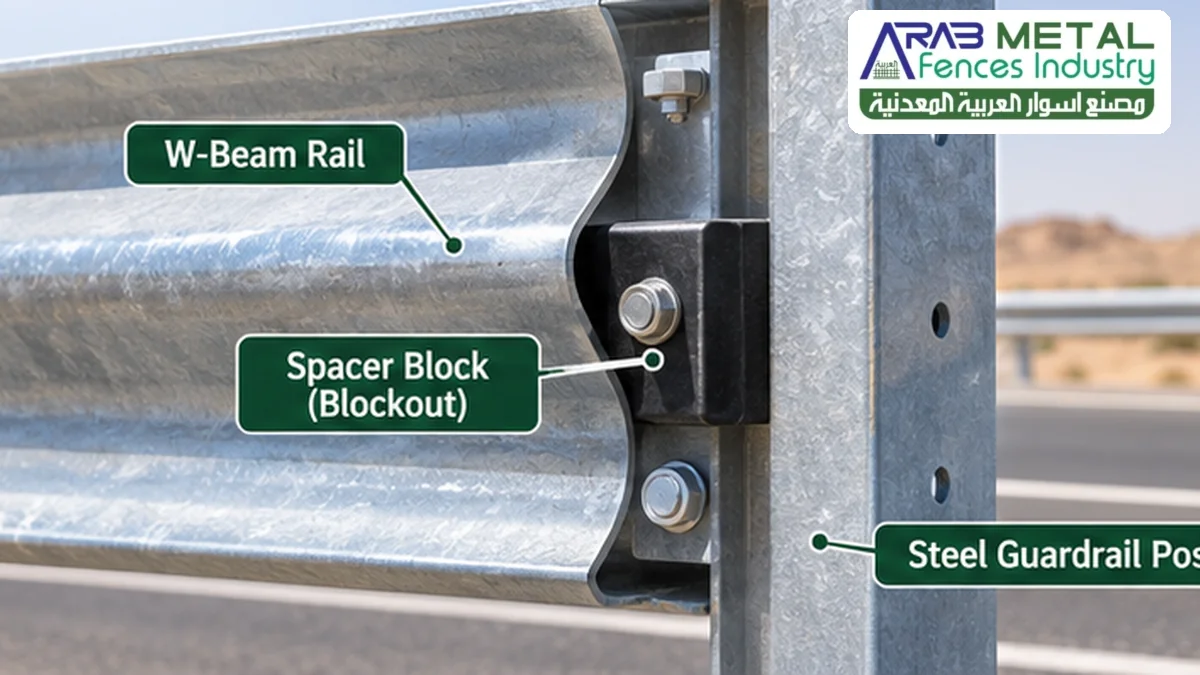
A roadside guardrail consists of several connected components. These may include steel rails, posts, blockouts, bolts, terminals, and transition elements.
Each component contributes to the performance of the complete assembly.
W-Beam Guardrail Systems
W-beam guardrails use corrugated steel rails supported by posts at specified intervals.
During an impact, the approved assembly is intended to respond according to its evaluated performance characteristics.
However, changing post spacing, connection details, or supporting conditions can alter that response.
Consequently, contractors should follow the approved drawings rather than select components independently.
Thrie-Beam Guardrail Systems
Thrie-beam rails have a different corrugated profile and are used in selected roadside safety configurations.
Some applications involve transitions or other barrier arrangements with specific performance requirements.
However, a Thrie-beam rail should not automatically be installed using posts or connections specified for another system.
The complete configuration must have appropriate technical approval.
Blockouts, Bolts and Connections
Some guardrail systems use spacer blocks, also known as blockouts, between the rail and the post.
Their dimensions and position can influence how the barrier responds during an impact.
Likewise, bolts, washers, and connection details must match the approved assembly.
The Federal Highway Administration explains how roadside guardrail performance is evaluated through system-level crash testing.
Steel Guardrail Post Types: C, U and H Sections
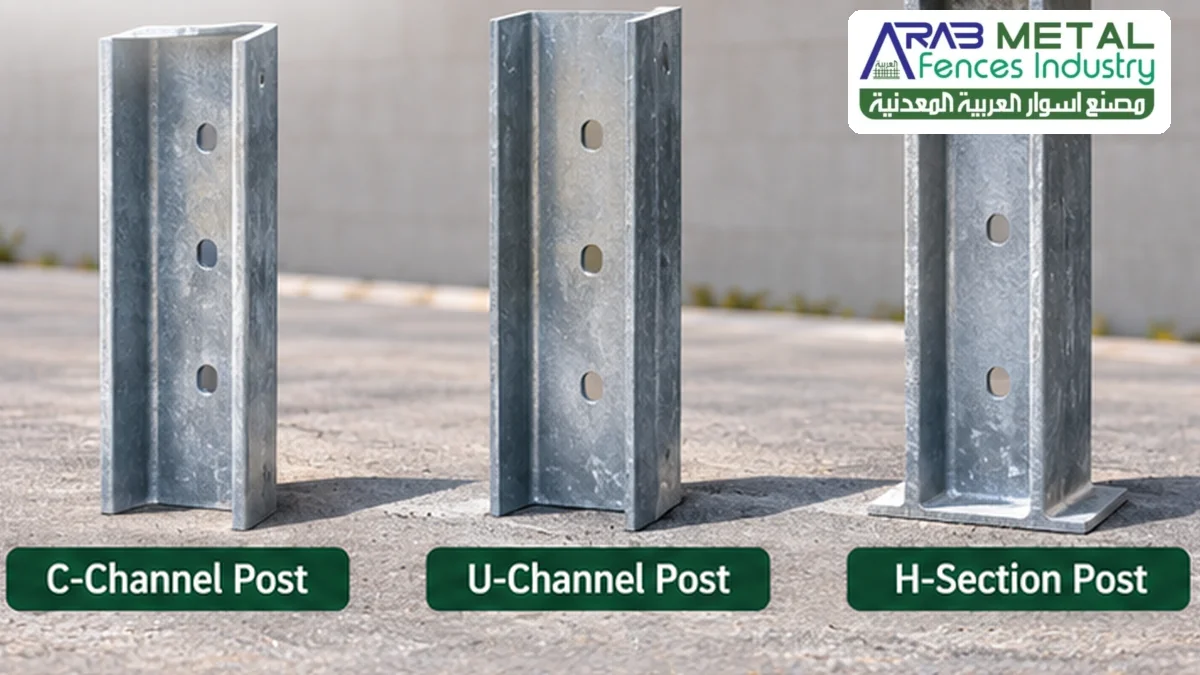
Steel guardrail posts can have different structural profiles. However, the correct section depends on the specified barrier system.
Arab Fences lists C-, U-, and H-section options within its published highway guardrail information.
C-Channel Guardrail Posts
C-channel posts have an open steel section. Their dimensions and connection details vary according to the intended system.
Before ordering, verify the section width, depth, thickness, and required hole pattern.
A C-channel post should not replace another profile without approval.
U-Channel Guardrail Posts
U-channel posts have a channel-shaped cross-section.
However, the general profile name does not establish compatibility with every guardrail assembly.
Therefore, buyers should confirm the exact geometry and approved connection arrangement.
H-Section Guardrail Posts
H-section posts have a flanged structural profile.
Their mechanical properties depend on the steel grade, section dimensions, and supporting conditions.
Nevertheless, a larger or heavier H-section should not be treated as an automatically acceptable replacement for another post.
Steel Guardrail Post Profile Comparison
| Profile | Main Characteristic | What to Verify |
|---|---|---|
| C-channel | Open steel section | Dimensions, thickness, holes and system compatibility |
| U-channel | Channel-shaped section | Exact profile and approved connections |
| H-section | Flanged steel section | Material grade, geometry and supporting arrangement |
| Other approved profiles | System-specific construction | Manufacturer drawings and performance documentation |
These profiles are not universally interchangeable. The selected post must follow the project specifications and approved barrier configuration.
Steel Guardrail Post Specifications: What Should You Check?
Accurate specifications help contractors avoid incompatible components and incorrect deliveries.
For example, two posts may look similar but have different steel grades, hole patterns, or protective coatings.
Steel Grade and Material Standards
The material grade defines important properties of the steel.
Saudi Highway Code SHC 403 lists SASO ASTM A36 among the material standards for steel guardrail posts. However, the applicable grade must also meet the specific approved system requirements.
Material compliance does not establish the crashworthiness of a complete barrier.
Section Dimensions and Wall Thickness
The post profile should be described using its exact cross-sectional dimensions and thickness.
For example, Arab Fences publishes a post configuration described as 150 × 100 × 5 mm, with a length of 1830 mm, in its highway guardrail product information.
These figures describe a published product configuration. They are not universal dimensions for every highway guardrail system.
Therefore, contractors must confirm the required dimensions using approved project drawings.
Post Length and Connection Holes
Post length is an important manufacturing specification.
However, total length does not determine the correct embedment depth or finished rail height on its own.
In addition, bolt holes must match the specified connections.
Hole dimensions, position, and orientation should follow the relevant fabrication drawings.
Steel Guardrail Post Specification Checklist
| Specification | Required Information |
|---|---|
| Post profile | Approved C-, U-, H-section or other profile |
| Steel grade | Specified material grade and standard |
| Section dimensions | Exact width, depth and thickness |
| Post length | Required manufactured length |
| Hole pattern | Diameter, location and spacing |
| Protective coating | Required galvanizing specification |
| Compatible rail | Approved W-beam or Thrie-beam system |
| Connection hardware | Specified bolts, nuts, washers and blockouts |
| Supporting arrangement | Approved installation details |
| Documentation | Drawings, material certificates and inspection requirements |
The information above helps establish a clear purchasing specification.
However, final acceptance depends on the complete project requirements.
Have approved guardrail drawings? Share your post dimensions and material requirements with Arab Fences for a project-specific quotation.
Galvanized Steel Guardrail Posts in Saudi Arabia
Galvanizing helps protect steel guardrail components against corrosion.
This is important because roadside infrastructure can experience different environmental conditions across Saudi Arabia.
Why Galvanizing Matters
Galvanizing applies a zinc coating to steel.
The coating provides barrier protection and can help protect exposed steel through sacrificial action.
However, long-term performance depends on coating requirements, environmental exposure, and maintenance.
Coating Standards and Documentation
Saudi Highway Code SHC 403 includes requirements for galvanizing steel road safety components.
It identifies ASTM A123 or ASTM A153, as appropriate, where other galvanizing requirements are not specified.
Therefore, buyers should confirm the applicable standard and inspection requirements before manufacturing.
Protecting the Complete Assembly
Corrosion protection should cover the specified components of the barrier system.
These may include:
- Steel guardrail posts.
- W-beam or Thrie-beam rails.
- Spacer blocks and supporting steel parts.
- Bolts, nuts and washers.
- Terminals and other exposed metal components.
However, coating specifications must remain compatible with the approved system.
Coastal and Industrial Conditions
Coastal locations may expose steel to airborne chlorides and moisture.
Meanwhile, some industrial environments can create additional corrosion concerns.
Consequently, the protective finish should match the project requirements and actual exposure conditions.
Buyers should also review the required inspection and maintenance procedures.
Post Spacing, Rail Height and System Compatibility
Steel guardrail posts must be installed in the positions required by the approved system.
Post spacing, rail height, and connection details influence the performance of roadside barriers.
Why Post Spacing Matters
Post spacing influences how loads are transferred through the barrier during an impact.
Different systems may use different spacing arrangements.
Therefore, contractors should not apply one standard spacing to every guardrail project.
Why Rail Height Matters
The finished rail height affects how vehicles interact with the barrier.
However, different systems may have different height requirements and installation tolerances.
Consequently, crews must follow the approved measurement method and system drawings.
Why Component Substitution Is Risky
Rails, posts and blockouts may appear similar across different products.
Nevertheless, visual similarity does not establish technical compatibility.
Any change in post profile, spacing, rail height, or connection arrangement should be evaluated and approved through the appropriate project process.
In addition, contractors should ensure that current drawings and revision numbers are used during procurement and installation.
Driven, Embedded and Base-Mounted Guardrail Posts
The supporting arrangement can influence how a guardrail post behaves during an impact.
Therefore, installation should follow the approved barrier configuration and site requirements.
Driven Steel Posts
Some guardrail systems use posts driven into suitable soil.
In these arrangements, the ground helps resist post movement.
However, soil conditions and installation details can affect the support response.
As a result, the required embedment and surrounding ground conditions must match the approved design.
Concrete-Embedded Posts
Some project specifications permit posts to be set in concrete.
However, concrete support can behave differently from soil support.
Therefore, concrete embedding should only be used where the approved guardrail design and project requirements permit it.
Base-Mounted Posts
Some specially designed barrier configurations use base plates and anchors.
However, base-mounted posts are not universally suitable replacements for driven posts.
The supporting structure, anchor arrangement, and complete barrier configuration require appropriate approval.
When Site Conditions Need Additional Review
Special attention may be required near slopes, pavement edges, drainage structures, and other constrained locations.
These conditions can influence the support available to the posts.
Therefore, any proposed design change should be reviewed by the responsible engineer.
Material Compliance vs Crash-Tested Guardrail Performance
A material certificate confirms selected properties of a component. However, it does not demonstrate that the complete roadside barrier meets a specified impact performance level.
This distinction is essential when purchasing guardrail components.
What Does ASTM A36 Confirm?
ASTM A36 is a steel material specification.
Where applicable, it helps establish requirements for the specified steel product.
However, it does not certify that a finished guardrail assembly has passed vehicle crash testing.
What Does Saudi Highway Code Require?
Saudi Highway Code SHC 403 addresses highway guardrail materials and construction.
It requires guardrail system performance and approval to follow the applicable SASO EN 1317 or MASH requirements in accordance with SHC 304.
Contractors should review the current approved code, project drawings, and authority requirements before procurement.
The Saudi Highway Code portal provides access to the relevant official documentation.
What Documents Should Buyers Request?
Depending on the project, required documentation may include:
- Approved barrier system drawings.
- Relevant crash-test or acceptance documentation.
- Specified performance classification.
- Steel material certificates.
- Post and rail fabrication details.
- Galvanizing specifications and inspection records.
- Approved terminal and transition details.
- Installation and maintenance instructions.
These documents serve different purposes. Therefore, one certificate should not be treated as a replacement for the others.
Most importantly, product availability does not automatically establish approval for a particular road safety application.
Common Steel Guardrail Post Mistakes to Avoid
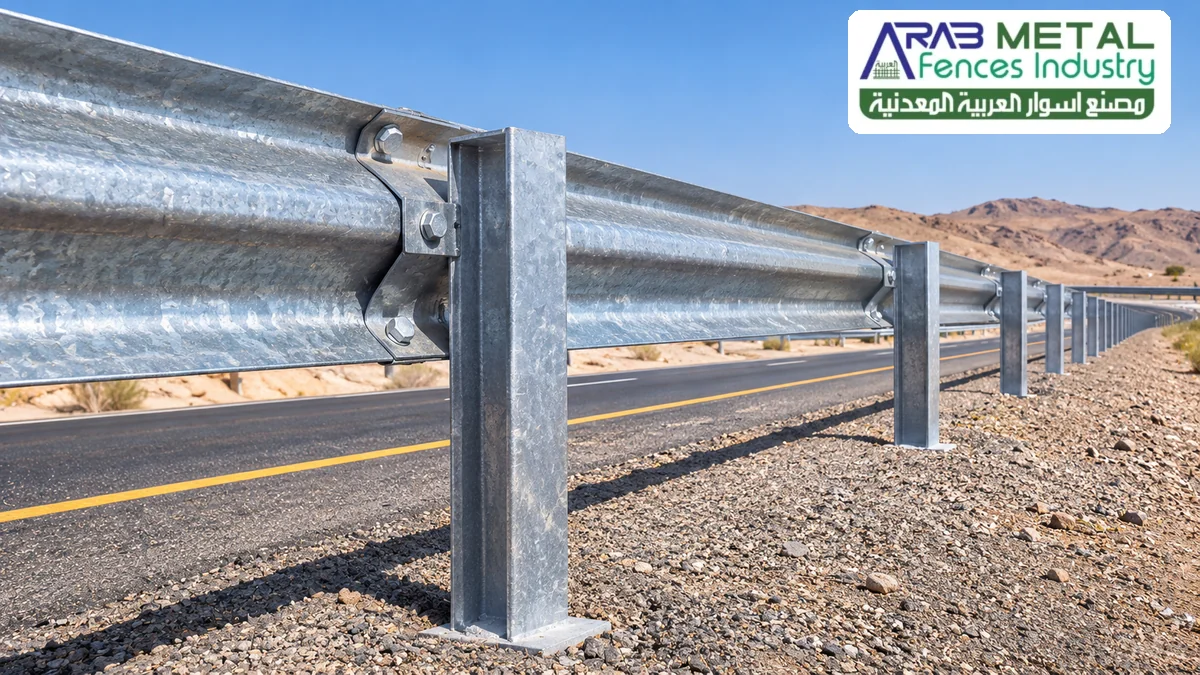
Incorrect specifications can cause problems during procurement and installation.
The following mistakes deserve particular attention.
- Choosing posts by size alone: Verify the complete profile, grade, holes and compatible system.
- Changing approved spacing: Use the arrangement specified in the approved drawings.
- Ignoring supporting conditions: Review soil, pavement and foundation requirements.
- Mixing components: Do not combine unrelated rail, post or blockout configurations without approval.
- Confusing material and crash-test documents: Confirm both where required.
- Overlooking galvanizing: Specify appropriate corrosion protection for exposed components.
A complete technical review before ordering can help prevent these issues.
Inspection and Replacement of Steel Guardrail Posts
Steel guardrail posts require appropriate inspection throughout the service life of the barrier.
Vehicle impacts, environmental exposure, and maintenance activities may damage individual components.
What Should Inspectors Check?
Important inspection points include:
- Bent or displaced posts.
- Damaged rails and connections.
- Loose or missing bolts.
- Distorted blockouts.
- Changes in rail height or alignment.
- Visible corrosion or coating damage.
- Damaged terminals and transitions.
- Ground movement near supporting posts.
Inspection frequency and procedures should follow the responsible road authority and approved maintenance requirements.
When Is Replacement Necessary?
Damaged components may need replacement when they no longer meet the accepted system requirements.
However, maintenance teams should evaluate the surrounding barrier assembly before deciding on the repair scope.
For example, replacing a bent post without correcting damaged connections or rail alignment may leave the system unsuitable for service.
Use Compatible Replacement Components
Replacement steel guardrail posts should match the approved system specifications.
Before ordering, verify the profile, dimensions, grade, connection holes, and protective finish.
Any substitution should receive the required technical approval.
Need replacement guardrail components? Share the approved specifications and quantities with Arab Fences to discuss suitable available options.
Steel Guardrail Post RFQ and BOQ Checklist
A clear request for quotation helps suppliers understand the required materials and documentation.
For road infrastructure projects, buyers should submit approved drawings and a detailed BOQ whenever possible.
| Requirement | Information to Provide |
|---|---|
| Project location | City, road section or project reference |
| Applicable specification | Relevant contract and highway code requirements |
| Barrier system | Approved W-beam, Thrie-beam or other system |
| Post profile | C-, U-, H-section or specified profile |
| Steel grade | Required material standard and grade |
| Section dimensions | Width, depth and thickness |
| Post length | Required manufactured length |
| Connection holes | Diameter, position and spacing |
| Quantity | Required number of posts |
| Post spacing | Approved system arrangement |
| Protective finish | Galvanizing requirements |
| Connection hardware | Bolts, nuts, washers and blockouts |
| Support arrangement | Approved installation details |
| Documentation | Approved drawings, certificates and inspection requirements |
| Supply scope | Manufacturing, delivery and any additional services |
In addition, include the drawing revision numbers and delivery requirements.
If any specification is missing, identify it before confirming the order.
Ready to source guardrail components? Send your BOQ and required quantities to Arab Fences to request a quotation.
Steel Guardrail Components from Arab Fences
Arab Fences is a Saudi manufacturer offering highway guardrail products and associated steel components.
Its published product information includes W-beam and Thrie-beam guardrails, along with steel post options.
Published Steel Post Configurations
Arab Fences lists galvanized C-, U-, and H-section steel posts.
Its product information includes a 150 × 100 × 5 mm section and a length of 1830 mm for a stated configuration.
However, these dimensions are examples from the published range. They should not be treated as standard dimensions for every project.
Compatible Rail and Hardware Requirements
Guardrail posts must match the specified rails, blockouts, and connecting components.
Therefore, buyers should provide approved system details instead of selecting parts independently.
Project-Specific Quotations
The required steel grade, dimensions, coating, quantity, and documentation can vary between projects.
Consequently, a quotation should reflect the approved technical requirements and supply scope.
Explore the Arab Fences Highway Guardrail product page for published product information.
Sourcing guardrail posts for a Saudi road project? Contact Arab Fences with your approved drawings and BOQ to discuss available components.
Frequently Asked Questions About Steel Guardrail Posts
1. What Are Steel Guardrail Posts?
Steel guardrail posts support rails in certain roadside safety barrier systems. Their dimensions, material properties, connections and installation must match the approved barrier configuration.
2. What Are the Main Types of Steel Guardrail Posts?
Common structural profiles include C-, U- and H-sections. However, the required profile depends on the selected guardrail system and project drawings.
3. Are Steel Guardrail Posts Used with W-Beam Barriers?
Yes. Many W-beam guardrail systems use steel posts. However, the exact profile, spacing and connections depend on the approved configuration.
4. Can the Same Posts Support W-Beam and Thrie-Beam Rails?
Not automatically. The posts must match the approved system. Any change to the specified components requires appropriate technical approval.
5. What Steel Grade Is Used for Guardrail Posts?
The grade depends on the project requirements. Saudi Highway Code SHC 403 lists SASO ASTM A36 among relevant steel post material standards, subject to the approved system specifications.
6. What Is the Standard Spacing Between Guardrail Posts?
There is no universal spacing for every barrier system. Contractors must follow the approved drawings and relevant performance documentation.
7. Are Galvanized Guardrail Posts Rustproof?
No. Galvanizing helps protect steel from corrosion, but it does not make the material permanently rustproof. Performance depends on the coating and environmental exposure.
8. Can Steel Guardrail Posts Be Installed in Concrete?
Only where the approved system and project requirements permit that support arrangement. Concrete embedding should not be treated as an automatic alternative to driven posts.
9. Does a Stronger Guardrail Post Improve Safety?
Not necessarily. Crashworthiness depends on the complete barrier assembly. Changing the post stiffness or profile may affect the intended system response.
10. How Can I Request Steel Guardrail Posts in Saudi Arabia?
Prepare the approved barrier drawings, post profile, material grade, dimensions, coating requirements and quantities. Then contact Arab Fences to request a project-specific quotation.
Request Steel Guardrail Posts for Your Highway Project
Steel guardrail posts must match the approved roadside barrier system, not just the required dimensions. The post profile, steel grade, connections, spacing and supporting conditions all influence compatibility. In Saudi Arabia, contractors should also check applicable highway code requirements and system-level performance documentation. A clear BOQ and approved drawings help reduce procurement errors and support accurate project planning.
Request steel guardrail posts for your Saudi road project. Contact Arab Fences today with your approved drawings and technical specifications.