
Choosing the right steel fencing systems for a project in Saudi Arabia requires more than comparing fence heights or panel prices. Different systems use different mesh configurations, wire specifications, protective finishes and supporting components. These differences affect their suitability for residential properties, commercial premises, industrial facilities and sites with particular perimeter requirements.
Welded mesh, chain link and specialized close-mesh security fencing are not interchangeable. The correct solution depends on the intended application, environmental exposure, access needs and complete technical specification.
This guide explains the main steel fencing types, their differences, essential specifications, corrosion protection options and the information required to obtain an accurate quotation from Arab Fences.
Planning a fencing project? Contact Arab Fences to explore available steel fencing systems and request a project-specific quotation.
Steel Fencing Systems: What Are They?
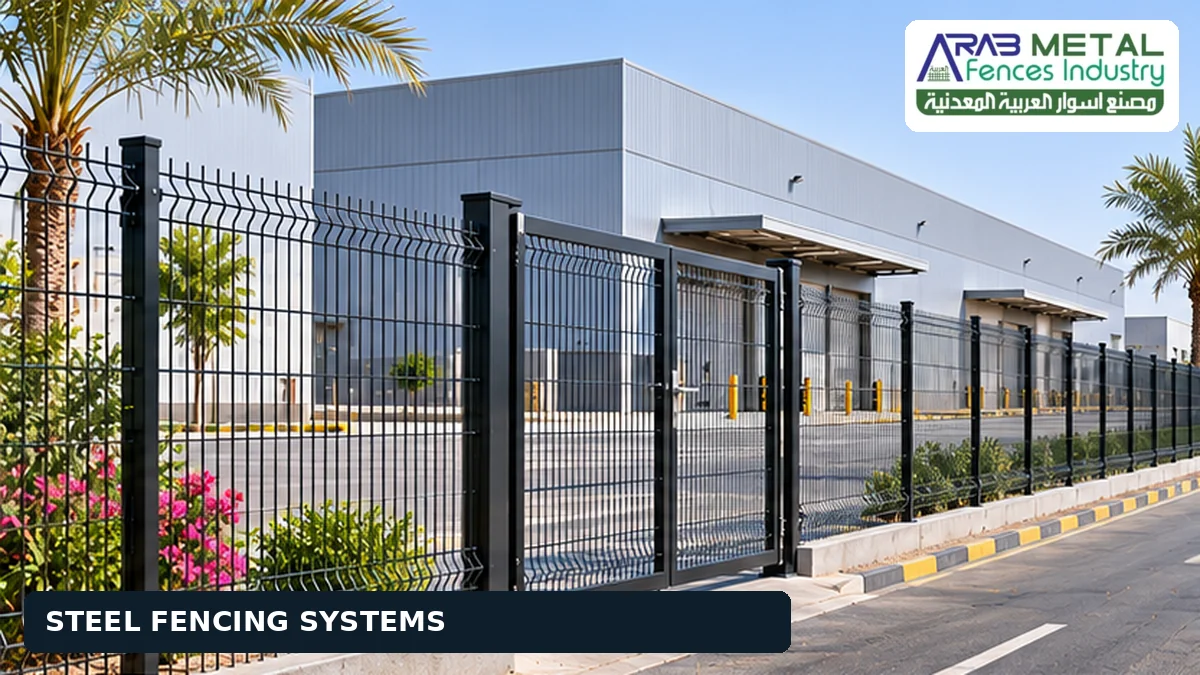
Steel fencing systems are perimeter assemblies constructed from steel mesh, panels or other metal elements supported by compatible posts, connections and access components.
A complete system must suit the selected location, fence dimensions, intended application and relevant site conditions. The specification should cover the visible fencing material as well as the supporting structure.
What Makes a Complete Steel Fence?
Depending on the design, a complete system may include:
- Rigid welded mesh panels or woven steel wire fabric.
- Supporting steel posts and compatible connections.
- Clamps, brackets, bolts, ties or tensioning accessories.
- Corner and terminal components.
- Entrance gates and gate posts.
- Protective galvanized or coated finishes.
- Suitable foundations or supporting structures.
- Additional perimeter components where specified and permitted.
These components vary between products. A rigid welded panel normally uses different connections from flexible chain link fabric.
Why Does System Selection Matter?
A steel fence should be selected according to its intended purpose rather than appearance alone.
An open mesh system may define a visible perimeter but provide limited privacy. A specialized close-mesh design may address different security-related requirements, although its performance must be verified against the relevant project specification.
No steel fence should automatically be described as impossible to climb, impossible to cut or completely maintenance-free.
Main Types of Steel Fencing Systems
Arab Fences manufactures several metal fencing products in Saudi Arabia, including 3D welded mesh, chain link and specialized anti-climb/anti-cut systems.
Each product has a different construction and supporting arrangement.
1. 3D Welded Mesh Fencing Systems
3D welded mesh fencing uses intersecting steel wires welded together to form rigid panels. The formed bends create a recognizable three-dimensional profile.
Arab Fences manufactures a 3D welded mesh fencing system made from low-carbon steel wire, with different options for panel dimensions, wire diameters, mesh openings and protective finishes.
The company’s published wire diameter range is 3 mm to 6 mm, depending on the selected configuration.
Common Applications of 3D Welded Mesh
The manufacturer identifies applications such as residential areas, commercial properties, public buildings, car parks, solar sites and retail premises.
Rigid welded mesh may be considered where a consistent panel arrangement and visibility through the boundary are suitable.
However, ordinary open mesh should not automatically be described as complete privacy fencing or a certified anti-climb system.
2. Chain Link Fencing Systems
Chain link fencing consists of steel wires interwoven into a diamond-shaped mesh.
Unlike rigid welded panels, chain link is relatively flexible and commonly supplied in rolls.
Arab Fences manufactures chain link fencing systems with different material and coating specifications.
The published product information includes:
- Wire diameters from 2 mm to 5.9 mm.
- Mesh openings from 40 × 40 mm to 80 × 80 mm.
- Standard heights from 0.5 m to 4 m.
- Roll lengths from 10 m to 25 m.
- Galvanized and vinyl/PVC-coated finishes.
- Compatible posts and matching gate configurations.
These are published specification ranges. The availability of a particular combination should be confirmed before ordering.
Where Can Chain Link Fencing Be Used?
Chain link may be considered for residential, commercial, industrial and other suitable perimeter applications.
Its open woven construction generally preserves visibility through the fence.
Different wire diameters, heights, mesh openings and supporting arrangements may be selected according to the project requirements.
Chain link alone does not establish a particular certified security level.
3. Anti-Climb and Anti-Cut Steel Fencing
Some facilities require more specialized perimeter specifications than those associated with conventional open mesh.
Arab Fences manufactures an anti-climb/anti-cut fencing system, described by the manufacturer as a 358-style security mesh system.
The published specification includes:
- Close mesh openings of 12.7 × 76.2 mm, with other sizes on request.
- Wire diameter options of 4 mm, 4.5 mm, 5 mm and 6 mm.
- Panel widths up to 2,500 mm.
- Different supporting post configurations.
- Specified galvanized and coated finishes.
Typical intended applications include industrial facilities, warehouses and other security-sensitive sites.
What Makes Close-Mesh Fencing Different?
Close-mesh systems use narrower openings than many conventional perimeter fencing products.
Their design may be relevant to projects with specific security objectives.
However, product names such as anti-climb and anti-cut should not be interpreted as proof that a system cannot be penetrated. Where tested performance is required, request appropriate technical documentation and evidence of compliance.
Need a standard or specialized perimeter system? Ask Arab Fences about available mesh configurations and technical specifications.
Welded vs. Woven Steel Fencing: Key Differences
Welded mesh and woven mesh differ in the way their wires are joined and supported.
Understanding these construction differences helps buyers identify the suitable material and accessories for their projects.
| Feature | Welded Mesh | Chain Link |
|---|---|---|
| Construction | Intersecting wires welded together | Interwoven steel wires |
| Common Supply Form | Rigid panels | Flexible fabric rolls |
| Opening Pattern | Specified welded grid | Diamond-shaped mesh |
| Supporting Components | Posts and panel connections | Posts, fabric attachments and tensioning accessories |
| Visibility | Generally open | Generally open |
| Protective Finishes | Depend on selected product | Depend on selected product |
| Primary Specification | Panel dimensions and welded mesh configuration | Fabric dimensions, mesh and supporting arrangement |
This table summarizes general construction differences. It is not a certified strength, security or cost comparison.
Does Welded Mesh Always Provide Greater Security?
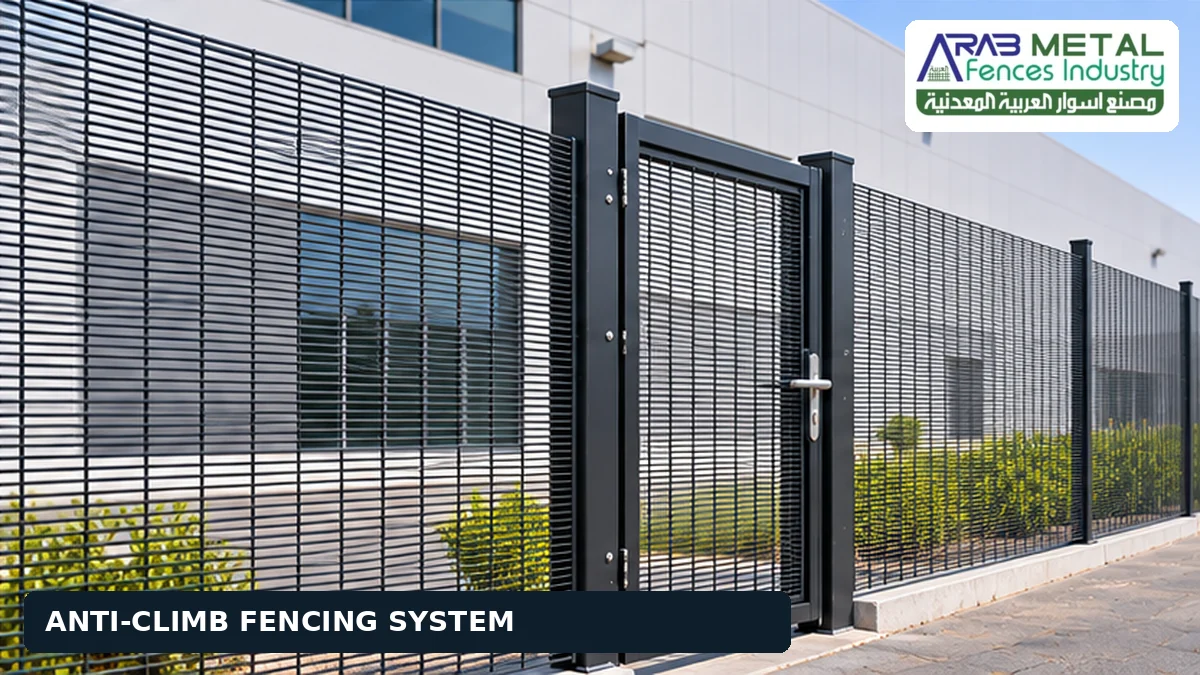
Not necessarily. Fence performance depends on the complete design, including materials, wire specifications, posts, connections, gates and site conditions.
A particular welded mesh panel should not automatically be considered superior to every chain link system.
Is Chain Link Always Cheaper?
Chain link may be economical for certain projects, but no fencing type is guaranteed to have the lowest total cost.
Compare equivalent material specifications, protective finishes, posts, gates and commercial scopes before making a decision.
Steel Fencing Applications in Saudi Arabia
Different properties and facilities require different steel perimeter arrangements.
Residential Properties
Residential fencing may prioritize boundary definition, appearance, visibility, access and maintenance.
Suitable welded mesh or chain link configurations can be considered where an open perimeter is acceptable.
For residential applications, explore our guide to metal garden fences.
Commercial Buildings and Retail Premises
Commercial sites may require clearly defined boundaries and planned entrances for customers, personnel or vehicles.
The selected system should suit the property layout and operational requirements.
Industrial Facilities and Warehouses
Industrial sites may need perimeter fencing, controlled access points and compatibility with operational areas.
Required specifications should account for height, mesh configuration, gates, posts, site exposure and any documented security criteria.
Solar Energy Sites
Solar projects may require extended perimeter fencing around equipment and associated facilities.
Arab Fences identifies solar sites among the applications of its 3D welded mesh and chain link products.
Car Parks and Public Facilities
Fencing can define parking boundaries and selected public-property perimeters.
Visibility, circulation, access points and maintenance should be considered during product selection.
Temporary Construction Boundaries
Where a temporary arrangement is needed, the company also offers a temporary fencing system.
Temporary systems are designed for different supporting and mobility requirements and should not be treated as equivalent to permanent fencing.
Key Technical Specifications for Steel Fencing Systems
Technical specifications determine whether a proposed fence matches the required application.
Fence Height and Total Length
The appropriate height depends on the purpose, property layout, applicable project requirements and supporting design.
Total length affects the required quantity of mesh, panels, posts and accessories.
Wire Diameter
Wire diameter describes the thickness of the steel wire.
Different fencing systems may use different diameters. However, wire thickness alone does not determine the strength or performance of a complete fence.
Material properties, mesh geometry and supporting components must also be considered.
Mesh Opening Dimensions
Mesh opening dimensions influence the appearance, visibility and configuration of a steel fence.
Welded mesh, chain link and specialized close-mesh systems use different opening patterns.
Panel Dimensions and Bends
For rigid panel systems, the dimensions and formed bends are part of the technical specification.
Panel size also affects the number and arrangement of supporting posts.
Posts, Connections and Gates
Post dimensions, spacing and connection types depend on the selected system.
Gate dimensions, operating hardware and supporting arrangements should be specified separately from fixed panel connections.
Arab Fences Published Specifications
| Specification | 3D Welded Mesh | Chain Link | Anti-Climb / Anti-Cut |
|---|---|---|---|
| Construction | Welded steel panels | Woven steel fabric | Close-mesh welded panels |
| Published Wire Diameter | 3–6 mm | 2–5.9 mm | 4, 4.5, 5 or 6 mm |
| Published Mesh Opening | Varies by configuration | 40 × 40 to 80 × 80 mm | 12.7 × 76.2 mm; other sizes on request |
| Supply Form | Rigid panels | Flexible rolls | Rigid panels |
| Supporting Arrangement | Posts and compatible clamps or fasteners | Posts and fabric attachments | Specified posts and connections |
| Protective Finishes | Galvanizing, polyester and PVC options | Galvanized and PVC/vinyl-coated options | Galvanized and specified coated options |
These values summarize published specifications. Actual dimensions, combinations, availability and performance requirements must be confirmed before ordering.
Have a technical drawing or bill of quantities? Send your specifications to Arab Fences to request suitable product information.
Galvanized vs. Coated Steel Fencing
The steel fencing system and its surface treatment are separate specifications.
Welded mesh and chain link describe the construction, while galvanizing, PVC coating and polyester coating describe protective treatments.
Hot-Dip Galvanized Steel Fencing
Hot-dip galvanizing involves applying zinc protection to prepared steel through immersion in molten zinc.
Zinc helps protect the underlying steel through barrier and sacrificial mechanisms.
However, actual performance depends on the coating specification, condition and environmental exposure.
For further technical information, review the Galvanizers Association guide to corrosion protection.
PVC-Coated Steel Fencing
PVC coating provides a polymer surface layer that may offer additional protection and colour options depending on the product specification.
Arab Fences publishes PVC-coated options for its chain link products and lists PVC coating among the surface treatments of its welded mesh system.
Polyester-Coated Fencing
Polyester coating may provide different colour finishes and additional surface protection when specified as part of a suitable coating system.
Arab Fences lists polyester-coated options for its 3D welded mesh products.
Published standard colours for that system include black RAL 9005 and green RAL 6005, with other colours on request.
Does Galvanized Steel Rust?
Galvanizing helps reduce corrosion risk, but no coating should be described as providing permanent protection under every condition.
Coating thickness, environmental exposure and visible damage may affect long-term performance.
Choosing the Appropriate Finish
Consider the project location, expected exposure, appearance requirements and relevant technical specifications.
Coastal and industrial environments may require particular attention to corrosion protection.
Need a specific galvanized or coated finish? Ask Arab Fences to confirm suitable options for your fencing system.
Steel Fence Posts, Gates and Connection Systems
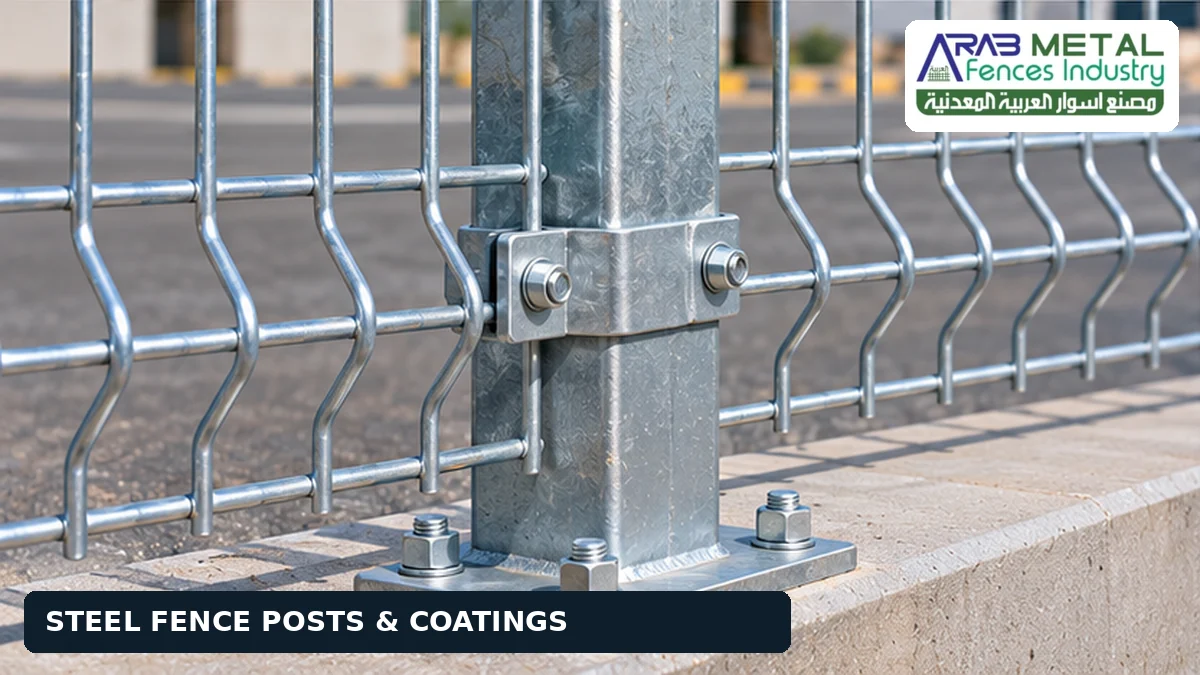
A steel perimeter fence must be considered as a complete assembly.
Supporting Steel Posts
Posts support the fencing and transfer relevant forces into the foundation or other suitable supporting arrangement.
The required post profile, dimensions, spacing and connection details depend on the selected fencing system and site conditions.
For a more detailed explanation, read our guide to types of fence posts.
Connections for Welded Mesh
Rigid welded mesh panels may be secured using compatible clamps, brackets and fasteners.
Connections should follow the manufacturer’s specification.
Chain Link Attachments
Chain link fabric may require compatible ties, tensioning components and other specified attachments.
Its supporting arrangement differs from that of rigid welded panels.
Entrance Gates and Hardware
Gates may require dedicated posts, hinges, latches and other hardware.
Gate configurations should meet the intended access requirements and match the selected perimeter system where available.
Ground and Foundation Conditions
Ground levels, slopes, corners, existing structures and relevant loads may influence the supporting arrangement.
Where engineering review or local approvals are required, these should be addressed before finalizing the design.
Security, Visibility and Access Control
Steel fencing can contribute to perimeter definition and access management, but its protective performance depends on the complete system.
Physical Boundary Definition
Fencing provides a visible separation between areas.
However, the level of access restriction depends on the fence configuration, gates, openings and other relevant measures.
Visibility Through the Fence
Conventional welded mesh and chain link generally allow views through their openings.
This may be suitable for projects where visibility is preferred, but it does not provide complete visual privacy.
Specialized Security Requirements
Security-sensitive projects may require particular mesh dimensions, post configurations, access arrangements or documented performance.
Arab Fences offers a specialized anti-climb/anti-cut system for relevant applications.
When a project calls for a certified security level, request appropriate test evidence and technical documentation.
Planning Access Points
Entrance positions, gate dimensions and required hardware form part of the perimeter plan.
Any additional access-control equipment or integration scope should be confirmed separately.
How to Select a Steel Fencing System for Your Project
A structured selection process helps buyers compare available systems and prepare clear enquiries.
Step 1: Define the Intended Application
Identify whether the fencing is required for a residential, commercial, industrial or specialized facility.
Step 2: Review the Site
Collect perimeter dimensions, ground levels, corner locations, site photographs and available drawings.
Step 3: Shortlist Suitable Systems
Compare welded mesh, chain link and specialized fencing against the intended purpose and project requirements.
Step 4: Confirm Technical Specifications
Identify required height, wire diameter, mesh opening, panel size and relevant standards.
Step 5: Select the Protective Finish
Choose a suitable finish according to environmental exposure and project specifications.
Step 6: Include Supporting Components
Account for posts, connections, gates, hardware and suitable foundations.
Step 7: Compare Complete Quotations
Check that competing quotations cover equivalent materials, components and commercial scopes.
Need to prepare a fencing enquiry? Contact Arab Fences with your dimensions, preferred system and technical requirements.
What Affects Steel Fencing System Costs in Saudi Arabia?
The cost of steel fencing systems depends on the selected configuration and complete project requirements.
Main Cost Factors
- Type of fencing system.
- Wire diameter and mesh opening dimensions.
- Panel size, fence height and total length.
- Galvanized or coated finish.
- Supporting posts and accessories.
- Gate quantity, dimensions and hardware.
- Site exposure and supporting conditions.
- Delivery and any separately agreed services.
A price for mesh or panels alone should not be compared directly with a quotation that includes complete supporting components.
Steel Fencing Quotation Checklist
| Requirement | Information to Provide |
|---|---|
| Location | Project city and site in Saudi Arabia |
| Project Type | Residential, commercial, industrial or specialized |
| Intended Use | Boundary, access management or specific perimeter requirement |
| Fence Dimensions | Total length, height and section measurements |
| Fence System | Welded mesh, chain link or anti-climb/anti-cut |
| Mesh Specification | Wire diameter, mesh openings and panel dimensions |
| Coating | Galvanizing, PVC, polyester or another specified finish |
| Posts and Gates | Required supporting components and access points |
| Technical Documents | Drawings, specifications and applicable requirements |
| Commercial Scope | Supply, delivery and any separately requested services |
If some technical details are unknown, provide the available project information and request clarification.
Steel Fencing Maintenance and Corrosion Protection
Steel fencing may require periodic inspection depending on the product, protective finish and environmental conditions.
Inspect the Surface Coating
Check for visible scratches, coating deterioration and exposed metal.
Repairs should follow the appropriate coating specification.
Review Mesh Panels and Fabric
Look for deformation, damage or deterioration affecting the selected fencing system.
Check Posts and Connections
Inspect accessible posts, clamps, fasteners and attachments for visible damage or movement.
Inspect Gates
Review hinges, latches, alignment and operating clearances.
Consider Environmental Exposure
Inspection requirements may vary between sheltered inland locations and sites exposed to demanding coastal or industrial conditions.
Follow the manufacturer’s product-specific maintenance guidance.
Common Steel Fencing Specification Mistakes
Confusing Welded Mesh with Chain Link
Rigid welded panels and woven chain link fabric have different construction and supporting requirements.
Treating Galvanizing as a Separate Fence Type
Galvanizing is a protective surface treatment rather than a mesh construction method.
Assuming Every Steel Fence Is Rustproof
Ordinary steel can corrode, making suitable coatings and maintenance important.
Choosing Wire Diameter Alone
Wire diameter is one specification among several that influence the completed system.
Assuming All Fences Have the Same Security Level
Specific security performance must be supported by suitable technical documentation and test evidence where required.
Ignoring Posts, Gates and Connections
These components are essential parts of the complete system specification.
Overlooking Site Conditions
Ground conditions, exposure and existing structures can influence the supporting arrangement.
Comparing Incomplete Quotations
Compare equivalent technical specifications and confirm the exact commercial scope.
Why Consider Arab Fences for Steel Fencing Systems?
Arab Fences manufactures metal fencing products locally in Saudi Arabia and publishes information about different perimeter fencing systems.
Multiple Published Fencing Products
The documented range includes 3D welded mesh, chain link and anti-climb/anti-cut fencing.
Technical Product Information
Product pages include details about selected materials, wire sizes, mesh openings, surface treatments and supporting components.
Applications Across Different Projects
The company identifies residential, commercial, industrial, public-building and other perimeter applications for its products.
Suitability must still be confirmed for each project.
Project-Based Quotations
Customers can provide dimensions, drawings and specifications to clarify available options and prepare an enquiry.
Contact Arab Fences to Discuss Your Steel Fencing Project and request the relevant product information.
Frequently Asked Questions About Steel Fencing Systems
1. What Are Steel Fencing Systems?
Steel fencing systems are assemblies made from steel mesh, panels, posts, connections and other components used to create boundaries or perimeters.
2. What Are the Main Types of Steel Fencing Systems?
Common types include rigid welded mesh, woven chain link and specialized close-mesh security-oriented fencing.
3. What Is the Difference Between Welded Mesh and Chain Link Fencing?
Welded mesh uses intersecting wires joined at their crossings to create rigid panels. Chain link uses interwoven wires forming flexible diamond-pattern fabric.
4. Can Steel Fencing Be Used for Industrial Sites?
Yes. Suitable steel fencing systems can be used for industrial boundaries when their specifications meet the project’s requirements.
5. Does Galvanized Steel Fencing Rust?
Galvanizing helps reduce corrosion risk, but long-term performance depends on the coating specification, condition and environmental exposure.
6. What Is the Difference Between Galvanized and PVC-Coated Fencing?
Galvanizing applies zinc protection to steel. PVC coating provides a polymer surface layer depending on the product configuration.
7. How Do I Choose the Right Steel Fence Height?
Consider the intended use, site conditions, applicable project standards, access requirements and supporting system.
8. What Components Are Included in a Steel Fencing System?
Depending on the product, components may include mesh panels or fabric, posts, connections, tensioning accessories, gates and suitable foundations.
9. What Affects Steel Fencing Costs in Saudi Arabia?
Costs depend on the system, dimensions, wire specifications, protective finish, posts, gates, site conditions and agreed commercial scope.
10. How Can I Request a Steel Fencing Quotation from Arab Fences?
Share your project location, perimeter measurements, selected fencing type, technical requirements, coating preferences, gate details and available drawings.
Request a Steel Fencing Systems Quotation from Arab Fences
Choosing suitable steel fencing systems requires comparing construction methods, technical specifications, corrosion protection and supporting components.
Welded mesh, chain link and specialized close-mesh fencing offer different options for residential, commercial and industrial projects. The correct system depends on the intended application and verified project requirements.
Arab Fences manufactures metal fencing products in Saudi Arabia and provides published technical information to support customer enquiries.
Request a Steel Fencing Systems Quotation from Arab Fences and share your project specifications, dimensions, coating preferences and technical documents.