
Wire mesh fence selection starts with understanding your property’s purpose, required security level, visibility, and environmental conditions. Whether you need fencing for a residential garden, commercial property, warehouse, or industrial facility in Saudi Arabia, choosing the correct mesh opening, wire diameter, protective coating, and support system is essential.
This guide explains how to compare available fencing solutions, avoid specification mistakes, and prepare the information needed for an accurate quotation.
Wire Mesh Fence Selection: How to Choose the Right System for Your Project
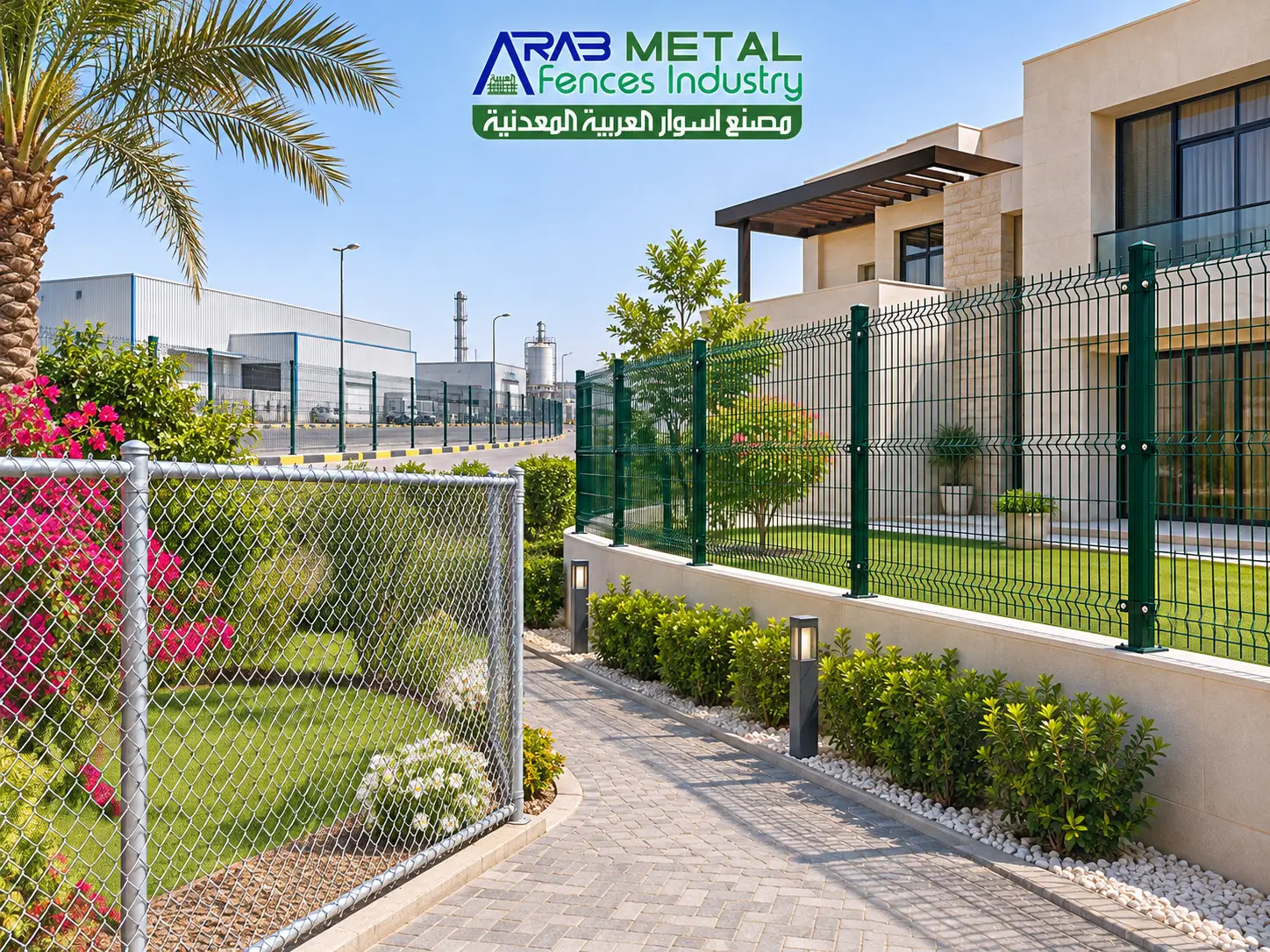
Successful wire mesh fence selection involves matching the fencing system to the intended application rather than choosing a product based only on appearance or initial cost. Different mesh structures provide different levels of rigidity, visibility, access control, and installation flexibility.
Chain link fencing can be a practical option for open boundaries and larger perimeters, while welded mesh panels offer a more structured appearance. For applications requiring stronger resistance to climbing or cutting, a purpose-designed security fencing system may be more suitable.
Before comparing products, identify the required fence height, boundary length, level of security, ground conditions, and exposure to corrosion.
Need guidance selecting a suitable fencing system? Contact Arab Fences to discuss your project specifications and request a quotation.
Which Wire Mesh Fence Is Best for Your Application?
The most suitable fencing system depends on where it will be installed and what it needs to achieve. Residential boundaries, commercial premises, and industrial facilities can have significantly different requirements.
| Application | Fencing Option to Consider | Main Considerations |
|---|---|---|
| Residential gardens | Chain link or 3D welded mesh | Appearance, visibility, gate access and height |
| Commercial properties | Welded mesh panels | Boundary definition, appearance and access control |
| Large land boundaries | Chain link fencing | Perimeter length, terrain and installation cost |
| Industrial facilities | Welded mesh or specified security fencing | Access control, protection requirements and durability |
| High-security locations | Anti-climb and anti-cut mesh | Security design, mesh configuration and installation |
| Recreational areas | Chain link or welded mesh | Visibility, safety and boundary requirements |
These recommendations provide a starting point. Final suitability depends on the complete fence specification and the conditions of the installation site.
Residential Wire Mesh Fencing
For residential properties, fencing often serves several purposes, including defining boundaries, managing access, and complementing the surrounding landscape.
Welded mesh panels may be attractive for modern homes because their rigid structure creates a uniform appearance. Chain link fencing can be useful for larger gardens where an economical, open boundary is preferred.
If your project involves a house or garden, explore the options discussed in our residential wire mesh fence guide.
Commercial and Industrial Fencing
Warehouses, workshops, commercial sites, and industrial facilities may require more controlled access and a stronger perimeter specification than a typical garden fence.
Fence height, mesh dimensions, wire thickness, post spacing, gates, and foundations should be considered together.
Where the site has specific security requirements, the project may require dedicated anti-climb fencing rather than a conventional open-mesh system.
Fencing for Large Outdoor Boundaries
For extensive land boundaries, the total perimeter can make material quantities and installation efficiency important cost considerations.
Chain link fencing is worth comparing when an open boundary with practical installation flexibility is acceptable. Its suitability for uneven terrain depends on the site layout, post locations, and installation method.
Chain Link vs Welded Mesh Fencing: Understanding the Differences
Two commonly considered metal fencing systems are chain link fencing and welded mesh fencing. Although both create visible boundaries, their construction and installation characteristics differ.
Chain Link Fencing
Chain link fencing uses interwoven steel wires to form a flexible diamond-shaped mesh.
Its open structure allows airflow and visibility. It can be used for gardens, land boundaries, recreational areas, and various commercial applications.
Arab Fences offers chain link fencing with different wire diameters, mesh openings, heights, and protective finishes.
Installation normally requires appropriately specified posts, tensioning components, and secure connections.
3D Welded Mesh Fencing
Welded mesh fencing consists of steel wires joined at their intersections to create rigid panels.
Some panel designs incorporate V-shaped bends that contribute to panel rigidity and provide a distinctive appearance.
Arab Fences supplies a 3D welded mesh fencing system with different panel and wire specifications.
This type of fence may suit residential, commercial, and industrial boundaries where panel consistency and a structured appearance are important.
Practical Comparison
| Feature | Chain Link Fence | Welded Mesh Fence |
|---|---|---|
| Structure | Flexible woven mesh | Rigid welded panels |
| Appearance | Traditional open-mesh design | Uniform panel design |
| Mesh configuration | Diamond-shaped openings | Typically rectangular openings |
| Installation | Requires suitable tensioning | Requires panel alignment and fixings |
| Terrain | Can accommodate certain irregular layouts | May require stepped installation |
| Privacy | Limited without screening | Limited without screening |
| Cost | Often economical for long boundaries | Depends on panel specifications and installation |
Comparing chain link and welded mesh for your property? Ask Arab Fences for a quotation based on equivalent heights, coatings, components, and installation requirements.
How Mesh Opening Affects Fence Performance
Mesh opening is one of the most important technical considerations when choosing a wire mesh fence.
It describes the dimensions of the spaces between the wires. Depending on the fencing system, openings may be diamond-shaped, square, or rectangular.
Small Mesh Openings
Smaller openings can help restrict the passage of larger objects and may be useful in applications requiring closer mesh spacing.
However, opening size alone does not establish a fence’s security performance. Wire strength, joints, posts, and the full system design also matter.
Large Mesh Openings
Larger openings may use less wire for an otherwise comparable configuration and can provide an open appearance.
They are not necessarily appropriate for locations with specific access-control, containment, or safety requirements.
Why Opening Shape Matters
Diamond-shaped chain link mesh is flexible because its wires are interwoven. Welded mesh panels have wires joined at fixed intersections, creating a more rigid structure.
Buyers should therefore compare both mesh dimensions and construction type before deciding which system suits their project.
For further information about different configurations, read our guide to wire netting fence sizes and applications.
Wire Diameter: How Thick Should Your Fence Wire Be?
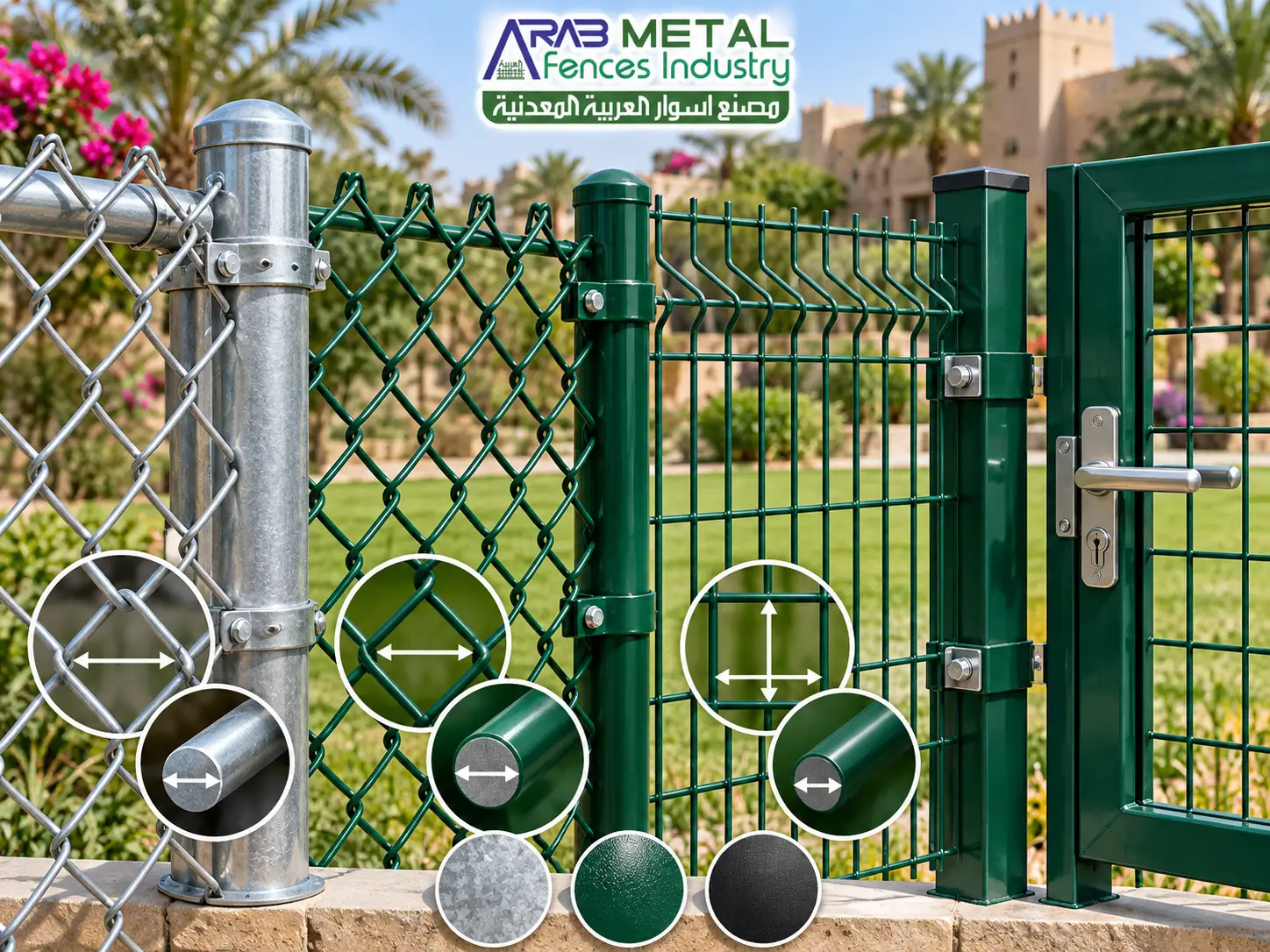
Wire diameter affects material consumption, mechanical properties, weight, and cost.
When comparing wires made from the same material, a larger diameter generally means a greater cross-sectional area. However, overall fence performance also depends on wire grade, mesh geometry, fabrication quality, and installation.
Thin Wire vs Thick Wire
A lighter wire configuration may be appropriate for some low-demand applications, while other boundaries require a more substantial specification.
It is important not to assume that the thickest available wire is automatically the best choice. Unnecessary material thickness can increase cost without addressing the project’s actual requirements.
Published Product Specifications
Arab Fences lists chain link fencing with wire diameters ranging from approximately 2 mm to 5.9 mm and mesh openings from 40 × 40 mm to 80 × 80 mm.
Its 3D welded mesh system offers different panel configurations and wire sizes, including options from approximately 3 mm to 6 mm.
These published ranges help identify possible configurations, but exact combinations and project suitability should be confirmed with the supplier.
How to Specify Wire Diameter Correctly
When requesting a quotation, clarify whether the stated diameter refers to the steel wire itself or includes an additional protective coating.
This distinction can matter when comparing galvanized and PVC-coated systems from different suppliers.
Galvanized vs PVC-Coated Wire Mesh Fencing
Protective coatings influence the appearance, corrosion resistance, maintenance, and long-term value of metal fencing.
The right finish depends on the fencing material, installation environment, and project specification.
Galvanized Wire Mesh Fencing
Galvanizing uses zinc to protect steel against corrosion.
Hot-dip galvanized coatings on fabricated iron and steel articles can be specified using ISO 1461:2022, where applicable to the product and manufacturing process.
The International Organization for Standardization provides information about the scope and requirements of this standard.
Not all galvanized fencing products use identical coating methods or thicknesses, so these details should be checked before purchase.
PVC-Coated Wire Mesh Fencing
PVC-coated wire mesh provides a coloured exterior finish around the underlying wire.
It is commonly considered where appearance and additional surface protection are relevant.
However, coating performance depends on the product design, base material, preparation, and installation conditions.
Powder-Coated Welded Mesh Panels
Powder coating is another finishing method used with certain metal fencing systems.
It can provide a coloured finish, including common green and black configurations, depending on the manufacturer’s available options.
For further guidance, explore the different wire mesh fence finishes and benefits.
Choosing Wire Mesh Fencing for Saudi Arabia’s Climate
Environmental exposure should influence the choice of fencing material and protective coating.
Saudi Arabian sites can experience intense sunlight, airborne dust, moisture, and varying levels of atmospheric corrosion exposure.
Inland Locations
Inland sites may be exposed to strong sunlight and dust accumulation. Coating condition, fastening components, and regular inspection should be considered during product selection.
Coastal Locations
Sites near the coast may face more demanding corrosion conditions because of airborne chlorides and moisture.
The appropriate corrosion-protection system should be selected according to the site’s exposure conditions rather than assuming one finish is suitable everywhere.
Exposed and Windy Locations
Wind loading is an important consideration for fences, especially where privacy screening, signs, or other attachments are proposed.
Posts, foundations, and connections must be designed for the intended configuration and applicable loads.
Installing a fence in a coastal, industrial, or exposed location? Share the site conditions with Arab Fences so the relevant material and coating requirements can be discussed.
Does Wire Mesh Fencing Provide Privacy and Security?
Wire mesh fencing can define boundaries and help control access, but privacy and security are not the same thing.
Conventional open-mesh fences generally allow people to see through them.
Privacy Limitations
Chain link and standard welded mesh panels do not normally provide complete visual privacy.
Additional screening may reduce visibility, but it can also increase wind loads and create new requirements for supporting structures.
Privacy additions should therefore be evaluated as part of the complete fencing design.
Security Requirements
Security performance depends on multiple factors, including fence height, mesh dimensions, wire strength, post arrangement, gate design, and resistance to unauthorised access.
A conventional garden fence should not be treated as equivalent to a purpose-built high-security barrier.
When to Consider Anti-Climb Fencing
For more demanding security applications, a dedicated anti-climb system may be required.
Arab Fences manufactures anti-climb and anti-cut fencing designed for applications where enhanced perimeter protection is important.
Its published product information describes 358-type mesh configurations and matching structural components.
The final system should be specified according to the site’s risk assessment and security requirements.
Common Wire Mesh Fence Selection Mistakes to Avoid
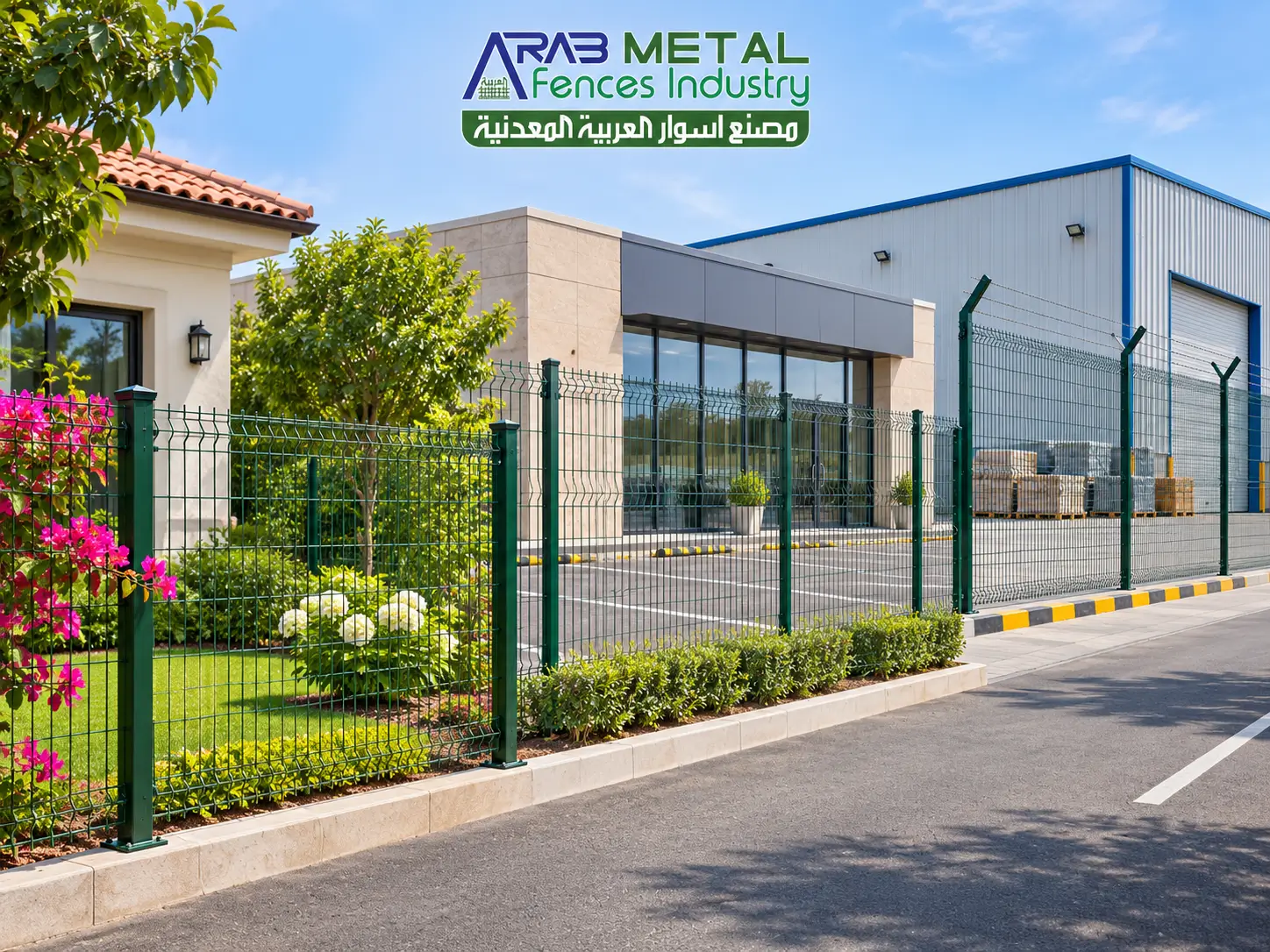
Many fencing problems begin with incomplete project requirements rather than the choice of material alone.
Choosing Only by Price
The cheapest initial quotation may exclude posts, foundations, gates, delivery, or installation work.
Compare complete fencing systems instead of individual mesh prices.
Ignoring the Site Environment
A finish appropriate for one location may require additional consideration in a more corrosive environment.
Ask suppliers to explain the protective coating included in the quotation.
Using the Wrong Mesh Opening
Mesh dimensions should match the required level of access control, containment, visibility, and safety.
Do not select an opening without considering the intended application.
Overlooking Posts and Foundations
Posts and foundations are fundamental to the stability of a fencing system.
Incorrect spacing, inadequate anchoring, or unsuitable installation details can affect performance.
Forgetting Gates and Access Requirements
Gate locations, dimensions, hardware, and supporting posts should be planned before the final quotation is approved.
How to Prepare Wire Mesh Fencing Specifications for a Quotation
A well-prepared quotation request helps suppliers recommend suitable systems and makes competing proposals easier to compare.
| Specification | Information to Provide |
|---|---|
| Project application | Residential, commercial, industrial or security |
| Location | City and site conditions in Saudi Arabia |
| Total fence length | Approximate perimeter in metres |
| Fence height | Required finished height |
| Fencing system | Chain link, welded mesh or security mesh |
| Mesh opening | Required dimensions or performance needs |
| Wire diameter | Required size or supplier recommendation |
| Protective finish | Galvanized, PVC-coated or other specified finish |
| Posts and foundations | Ground conditions and installation requirements |
| Gates | Number, dimensions and access requirements |
| Installation | Supply only or supply and installation |
When the technical requirements are not yet defined, provide the intended use and site details so the supplier can identify which specifications require further assessment.
Ready to compare fencing options? Request a quotation from Arab Fences with your project location, dimensions, intended application, and preferred finish.
Why Choose Arab Fences for Wire Mesh Fencing in Saudi Arabia?
Arab Fences is a Saudi fencing manufacturer offering metal fencing systems for residential, commercial, and industrial applications.
Its published product range includes chain link fencing, 3D welded mesh fencing, and anti-climb fencing, allowing customers to explore different configurations according to their requirements.
Different Fencing Systems
Customers can compare flexible chain link mesh, rigid welded panels, and dedicated security fencing rather than assuming one system is suitable for every project.
Technical Product Information
Published information includes relevant details such as wire diameters, mesh configurations, posts, protective finishes, and gate options.
Project-Specific Requirements
Fencing selection should reflect the intended use, site location, boundary dimensions, and installation conditions.
Arab Fences can be contacted to discuss the available options and request a quotation based on the required specifications.
Find the right fencing solution for your project. Contact Arab Fences today to discuss your wire mesh fencing requirements in Saudi Arabia.
Frequently Asked Questions About Wire Mesh Fence Selection
1. What Is the Best Wire Mesh Fence for Residential Properties?
Chain link and welded mesh fencing can both suit residential boundaries. Chain link may be useful for larger open areas, while welded mesh offers a more structured appearance. The best choice depends on the intended use, budget, and site conditions.
2. How Do I Choose the Correct Mesh Opening?
Choose the mesh opening according to visibility, containment, access-control, and safety requirements. Smaller openings are not automatically suitable for every application, so consider the complete fencing specification.
3. Does Wire Diameter Affect Fence Strength?
Yes. Wire diameter affects the cross-sectional area and mechanical characteristics of the wire. Overall fence performance also depends on material grade, mesh construction, posts, connections, and installation.
4. What Is the Difference Between Chain Link and Welded Mesh?
Chain link uses interwoven wires to form a flexible diamond-shaped mesh. Welded mesh uses wires joined at their intersections to create rigid panels, often with square or rectangular openings.
5. Is Galvanized Wire Mesh Suitable for Outdoor Use?
Galvanized steel can be suitable for outdoor fencing because its zinc coating helps protect against corrosion. Performance depends on the coating specification, product quality, and environmental exposure.
6. Can Wire Mesh Fencing Provide Complete Privacy?
Standard open-mesh fencing generally provides limited visual privacy. Additional screening may be considered, but it can increase wind loads and must be assessed alongside the fence structure.
7. Which Wire Mesh Fence Is Suitable for Industrial Sites?
Welded mesh, chain link, or dedicated security mesh may be appropriate depending on the facility’s access-control and perimeter requirements. Higher-risk locations may require a purpose-designed security system.
8. Is PVC-Coated Wire Mesh Better Than Galvanized Mesh?
Neither finish is automatically better for every project. The appropriate choice depends on the base material, coating method, appearance, environmental exposure, and maintenance requirements.
9. What Information Is Needed for a Wire Mesh Fence Quotation?
Provide the project location, boundary length, fence height, intended application, preferred mesh type, coating requirements, gate details, and installation scope.
10. Where Can I Request Wire Mesh Fencing in Saudi Arabia?
Arab Fences offers metal fencing systems for different applications. Customers can review its published products and contact the company to request a quotation based on their project specifications.
Make the Right Wire Mesh Fence Selection for Your Project
Wire mesh fence selection becomes easier when the application, mesh opening, wire diameter, protective finish, and installation requirements are clearly defined.
Chain link, welded mesh, and specialised security systems serve different purposes, so comparing the complete fencing solution is more valuable than focusing on a single specification. Arab Fences provides metal fencing options for projects across Saudi Arabia.
Ready to choose your fencing system? Contact Arab Fences to discuss your requirements and request a project-specific quotation.