
Confused about wire netting fence sizes when comparing fencing specifications? Mesh openings, wire diameter, fence height, and roll or panel dimensions are separate measurements that affect product selection and quotation accuracy.
Choosing the wrong combination can lead to unsuitable materials or incorrect quantities. This guide explains how to read these measurements, compare chain link and welded mesh, and request suitable fencing specifications from Arab Fences in Saudi Arabia.
Need accurate fencing specifications? Contact Arab Fences to discuss available wire mesh sizes and request a project quotation.
Wire Netting Fence Sizes: How Are They Measured?
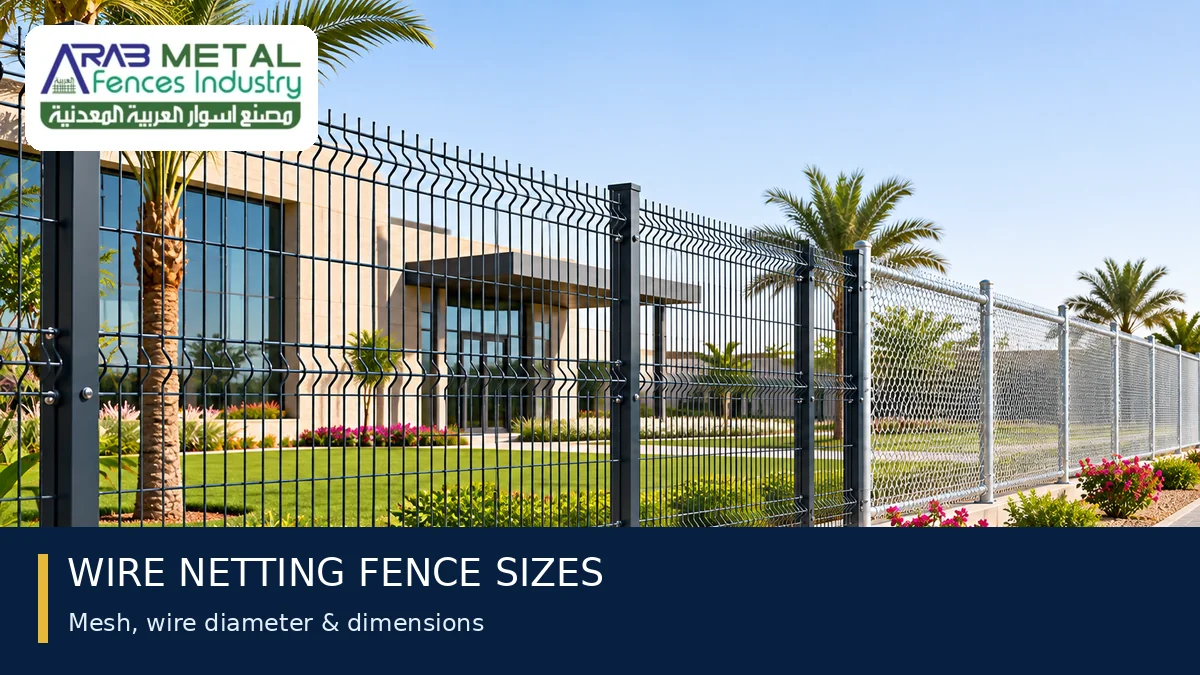
Wire netting fence sizes describe several independent measurements. Each dimension helps determine what material is being supplied and whether it is suitable for the intended boundary.
The most important measurements are mesh opening, wire diameter, fence height, roll length, and panel dimensions.
Mesh Opening Size
Mesh opening describes the space between the wires forming the mesh. Welded mesh generally uses intersecting wires, while chain link consists of woven wires arranged in a diamond pattern.
The measurement convention must follow the selected product specification. In particular, a chain link aperture should not automatically be interpreted as the full diagonal of its diamond-shaped opening.
Wire Diameter
Wire diameter describes the nominal thickness of an individual steel wire, usually expressed in millimetres.
For example, a diameter of 3 mm refers to the wire rather than the space between adjacent wires.
Fence Height
Fence height describes a vertical dimension. Depending on the specification, it may refer to the mesh fabric or panel itself rather than the total installed height of posts and other components.
Roll Length
Roll length describes the nominal length of flexible mesh supplied in a roll. A 20 m roll does not mean the fencing is 20 m high.
Panel Width and Height
Rigid welded mesh panels are specified by their height and width. The installed coverage also depends on the selected connections and post layout.
Mesh Opening Size vs. Wire Diameter
Mesh opening and wire diameter are separate technical measurements, even when both are expressed in millimetres.
What Does a 50 × 50 mm Opening Mean?
In a square welded mesh, a nominal 50 × 50 mm opening describes the mesh aperture according to the stated measurement convention.
It does not mean the wires are 50 mm thick.
What Does 3 mm Wire Diameter Mean?
A nominal 3 mm wire diameter identifies the thickness of the steel wire. It should be recorded separately from the mesh opening and panel or roll dimensions.
Example: Reading a Complete Specification
Consider the following illustrative specification:
Height: 1.8 m | Mesh: 50 × 50 mm | Wire: 3 mm | Roll Length: 20 m
| Measurement | Meaning |
|---|---|
| 1.8 m | Nominal height of the fencing fabric |
| 50 × 50 mm | Specified mesh opening |
| 3 mm | Nominal wire diameter |
| 20 m | Nominal roll length |
This example explains measurement terminology and does not represent a confirmed Arab Fences product configuration.
Does a Smaller Opening Mean a Stronger Fence?
Not automatically. Smaller mesh openings change the geometry and appearance of the material, but complete fence performance also depends on wire properties, supports, connections, and other design characteristics.
A particular security or structural performance level should only be claimed when supported by the relevant technical evidence.
Unsure how to interpret your mesh specification? Share your requirements with Arab Fences to confirm suitable available options.
Chain Link Fence Sizes and Specifications
Chain link fencing uses woven steel wires to form flexible diamond-shaped mesh fabric.
Arab Fences manufactures chain link fencing systems in Saudi Arabia, with published size and finish options.
Chain Link Wire Diameters
The company’s published range extends from 2 mm to 5.9 mm, with special diameters available on request.
For coated products, confirm whether the stated wire diameter refers to the steel core or the finished coated wire.
Chain Link Mesh Openings
Arab Fences publishes mesh opening sizes from 40 × 40 mm to 80 × 80 mm.
These are product ranges. The availability of a particular aperture with a specific wire diameter and finish must be confirmed.
Chain Link Fence Heights
Published standard fabric heights range from 0.5 m to 4 m.
The appropriate height depends on the purpose, applicable project requirements, and the complete supporting system.
Chain Link Roll Lengths
Published roll lengths range from 10 m to 25 m.
When estimating quantities, distinguish the nominal roll length from the usable coverage required by the final design.
Published Chain Link Size Chart
| Specification | Published Range |
|---|---|
| Wire Diameter | 2–5.9 mm |
| Mesh Opening | 40 × 40 to 80 × 80 mm |
| Standard Height | 0.5–4 m |
| Roll Length | 10–25 m |
| Construction | Woven steel wire fabric |
| Available Finish Categories | Galvanized and vinyl/PVC-coated options |
Published ranges do not guarantee that every dimension and finish can be combined in a single product.
How to Select Chain Link Dimensions
Start with the intended application and required fence height. Then review the mesh aperture, wire diameter, protective finish, posts, attachments, and gates.
Compare complete specifications rather than relying on one measurement.
Welded Mesh Fence Panel Sizes
Welded mesh fencing is different from chain link because intersecting wires are joined to form rigid panels.
Arab Fences manufactures a 3D welded mesh fencing system with multiple panel configurations.
Welded Mesh Wire Diameter
The manufacturer publishes wire diameter options from 3 mm to 6 mm.
The selected diameter should be evaluated alongside the actual panel geometry, material requirements, and supporting arrangement.
Mesh Opening Dimensions
3D welded mesh panels can have different opening sizes and patterns according to the product specification.
Buyers should request the actual technical sheet for the required configuration rather than assuming a common market opening is available.
Panel Height and Width
Rigid panel dimensions describe individual sections rather than fabric rolls.
The available panel heights and widths should be confirmed against the selected manufacturer’s configuration.
V-Bends and Panel Geometry
3D welded mesh panels include formed bends that give the panels their characteristic profile.
The number and arrangement of bends can vary with panel dimensions and product design.
Posts and Panel Connections
Rigid panels require compatible supporting posts and connections.
Do not assume that nominal panel width always equals the required distance between the centres of adjacent posts.
The installation layout should follow the approved system details.
Need specific welded mesh panel dimensions? Request current panel specifications from Arab Fences.
Wire Netting Fence Roll Sizes vs. Panel Sizes
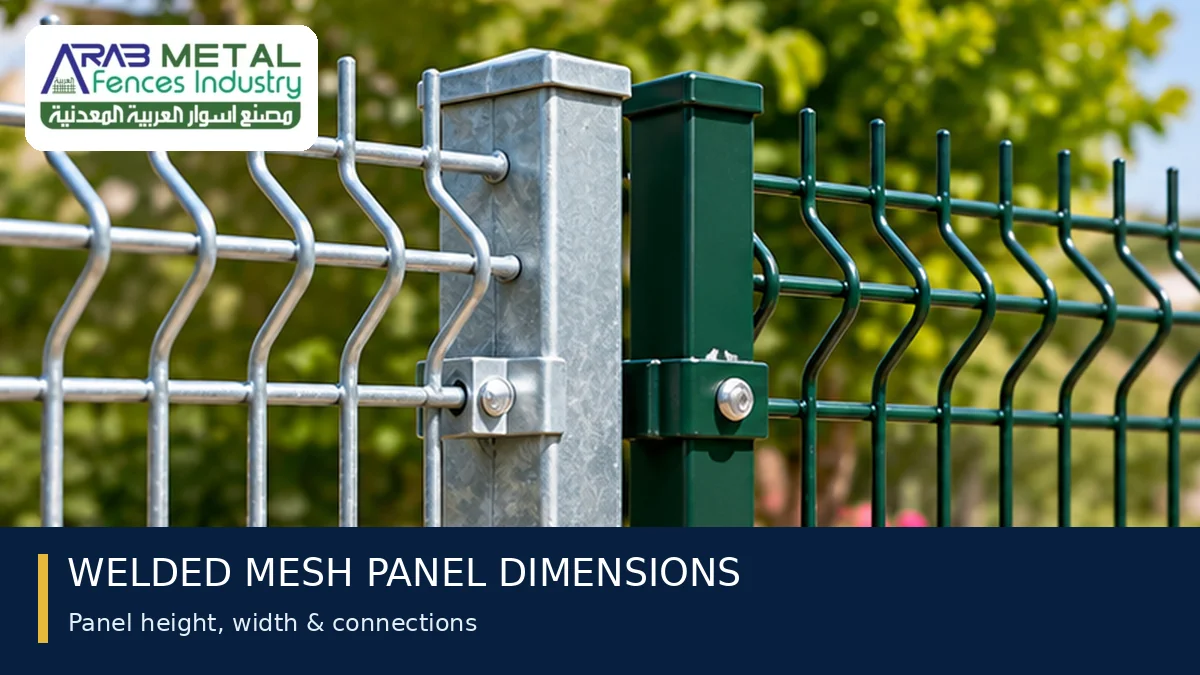
One of the biggest differences between chain link and rigid welded mesh is how the material is supplied and measured.
Roll Dimensions
Flexible chain link fabric is typically supplied in rolls identified by nominal height and length.
The mesh opening, wire diameter, and protective finish should also be included in the specification.
Panel Dimensions
Rigid welded mesh is supplied in individual panels identified by height and width, along with the wire diameter, opening dimensions, and other panel characteristics.
Roll and Panel Comparison
| Feature | Chain Link Roll | Welded Mesh Panel |
|---|---|---|
| Construction | Flexible woven fabric | Rigid welded mesh |
| Supply Unit | Roll | Individual panel |
| Principal Dimensions | Fabric height and roll length | Panel height and panel width |
| Connections | Fabric attachments and applicable tensioning components | Compatible panel fasteners and posts |
| Quantity Estimate | Based on usable fabric length | Based on installed panel coverage |
These construction differences affect how quantities and supporting materials should be calculated.
Comparing Common Wire Netting Fence Dimensions
The following comparison summarizes the published size information for Arab Fences mesh systems.
| Specification | Chain Link | 3D Welded Mesh |
|---|---|---|
| Wire Diameter | 2–5.9 mm | 3–6 mm |
| Mesh Opening | 40 × 40 to 80 × 80 mm | Depends on panel configuration |
| Published Heights | 0.5–4 m standard | Depends on panel configuration |
| Length or Width | 10–25 m roll length | Panel width depends on configuration |
| Supply Format | Woven fabric rolls | Rigid welded panels |
| Protective Treatments | Galvanizing and vinyl/PVC options | Galvanization, polyester and PVC options |
These measurements are published specification ranges rather than a current stock list. Confirm the required combinations before ordering.
How to Choose the Right Mesh Opening
The appropriate opening size depends on how the fence will be used.
Residential Gardens
For garden boundaries, consider appearance, visibility, access needs, and the intended application.
Conventional open mesh does not provide complete visual privacy.
For additional guidance, explore metal garden fences and available design options.
Commercial Boundaries
Commercial projects may require particular dimensions and post arrangements to support the intended boundary and access requirements.
Industrial Perimeters
Industrial fencing may need project-specific heights, mesh openings, gates, and connection details.
Any required performance level should be supported by the applicable technical documentation.
Animal Enclosures
For applications involving animals, consider the animal’s size and behaviour, mesh openings, height, ground clearance, and gate gaps.
Do not assume an ordinary wire mesh fence is automatically escape-proof or suitable for every animal.
Choosing Wire Diameter and Fence Height
Wire diameter and fence height are important, but neither measurement should be evaluated in isolation.
Does Thicker Wire Always Mean a Stronger Fence?
No. A larger wire diameter changes the wire’s cross-sectional area, but complete fence performance depends on material properties, geometry, posts, connections, and other requirements.
Any strength or security claim should relate to the complete system and relevant evidence.
How to Choose Fence Height
Review the intended boundary, applicable project specifications, site exposure, and supporting requirements.
There is no universal height appropriate for every garden, commercial property, or industrial facility.
Why Complete Specifications Matter
Two fences of equal height can have different mesh openings, wire diameters, coatings, and supporting systems.
They should not be treated as technically equivalent without comparing those details.
Post Spacing, Connections and Gates
Mesh dimensions are only part of a complete fencing specification.
Post Spacing
Post spacing depends on the selected system, panel or fabric arrangement, environmental exposure, and supporting requirements.
Rigid welded mesh panel width should not be treated as a universal post centre-to-centre spacing measurement.
Panel and Fabric Connections
Welded panels may be secured using specified clamps, brackets, or fasteners.
Chain link fabric may require different attachments and tensioning components.
Gate Dimensions
Gate openings should be measured and identified separately.
Gate posts, hinges, latches, and other hardware should suit the required opening and operating arrangement.
Ground Conditions
Slopes, corners, existing walls, and ground conditions may influence the supporting design.
For further detail, see our guide to types of fence posts and their applications.
Galvanized and PVC-Coated Wire Netting
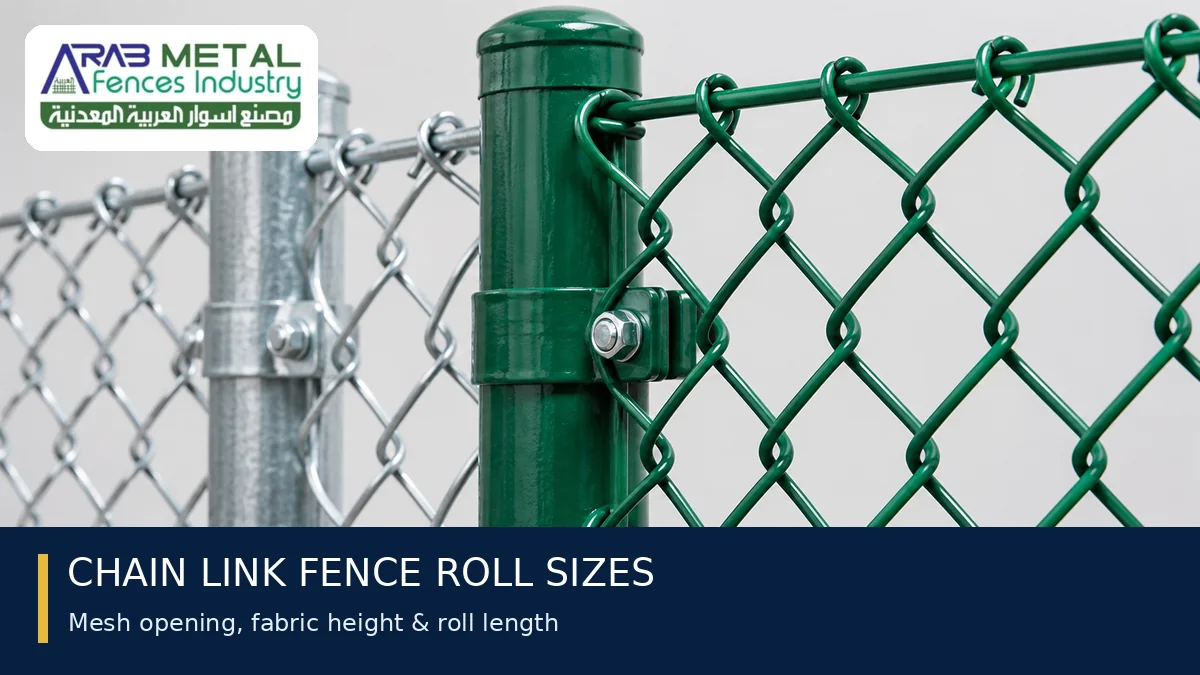
Mesh dimensions and protective finishes are independent specifications.
Galvanized Wire Netting
Galvanizing applies zinc protection to steel to help reduce corrosion.
Its effectiveness depends on the coating specification, condition, and environmental exposure.
According to the American Galvanizers Association, zinc provides both barrier and sacrificial protection to steel.
Galvanizing should not be described as making steel permanently rustproof or automatically increasing the structural strength of the entire fence.
PVC-Coated Wire Netting
PVC-coated wire uses a polymer surface layer, with characteristics depending on the underlying product specification.
When comparing coated products, clarify whether the nominal wire diameter is measured before or after coating.
Protective Finishes in Saudi Arabia
Environmental conditions such as coastal exposure, moisture, and airborne salts may influence coating selection.
Confirm the suitable protective finish against the actual project requirements.
Need a galvanized or coated wire mesh specification? Contact Arab Fences to confirm available finishes and sizes.
Wire Netting Fence Sizes for Different Applications
Wire netting dimensions should be selected according to the intended use rather than copied from an unrelated project.
Garden and Residential Boundaries
Residential fencing may prioritize a defined boundary, visibility, appearance, and compatible gates.
Commercial Properties
Commercial fencing may require specified heights, openings, connections, and access arrangements.
Industrial Facilities
Industrial projects may require particular mesh and supporting specifications to satisfy operational or technical requirements.
Solar Sites and Car Parks
Arab Fences identifies solar sites and car parks among the applications of its fencing products.
For an overview of complete perimeter options, read our guide to steel fencing systems.
How to Calculate Wire Netting Fence Quantity
Quantity estimation starts with the boundary dimensions and the selected product’s usable coverage.
The examples below are preliminary illustrations, not approved material takeoffs.
Step 1: Measure the Boundary
Measure each fence section and identify corners, gates, level changes, and existing structures.
Step 2: Identify Gate Openings
Record gate widths separately and exclude them from mesh lengths where appropriate.
For example, a 100 m boundary with a 4 m gate opening leaves a preliminary 96 m of fence sections, before other allowances.
Step 3: Estimate Chain Link Rolls
For a hypothetical 100 m length of chain link fabric with nominal 20 m rolls:
100 ÷ 20 = 5 rolls
This calculation assumes the full nominal fabric length is usable. Actual quantities may change after considering joints, cuts, terminal arrangements, corners, gates, and project allowances.
Step 4: Estimate Welded Mesh Panels
For a hypothetical straight boundary requiring 100 m of panel coverage, with 2.5 m of effective installed coverage per panel:
100 ÷ 2.5 = 40 panels
This is an illustrative calculation only. It does not confirm a 2.5 m Arab Fences product or approved post spacing.
Actual panel counts must use the selected system’s installed dimensions.
Step 5: Include Supporting Components
The bill of materials may also require intermediate posts, corner posts, terminal posts, gates, clamps, fabric attachments, and suitable foundations.
Step 6: Confirm the Final Takeoff
Use the selected product configuration and final drawings to confirm actual quantities before ordering.
Have a boundary plan? Share your measurements with Arab Fences to request a project-specific quotation.
What Affects Wire Netting Fence Prices?
Wire netting prices depend on the chosen specifications and the complete project scope.
Main Pricing Factors
- Wire diameter and steel specification.
- Mesh opening dimensions.
- Fence height and total length.
- Roll length or panel dimensions.
- Galvanized or coated finish.
- Posts, fasteners, and accessories.
- Gate quantity and dimensions.
- Site conditions and agreed commercial scope.
Compare complete fencing quotations rather than relying only on the price of a roll or panel.
Wire Netting Fence Quotation Checklist
| Requirement | Information to Provide |
|---|---|
| Project Location | City and site in Saudi Arabia |
| Application | Residential, commercial, industrial, or other |
| Fence Length | Total boundary length and section measurements |
| Fence Height | Required height in metres |
| Fence System | Chain link or welded mesh |
| Mesh Opening | Specified opening dimensions in millimetres |
| Wire Diameter | Required nominal wire diameter |
| Supply Format | Rolls or rigid panels |
| Roll or Panel Dimensions | Required dimensions or preferred configuration |
| Protective Finish | Galvanizing, PVC, polyester, or other specified coating |
| Supporting Components | Posts, connections, and gates |
| Technical Documents | Drawings and applicable specifications |
| Commercial Scope | Supply, delivery, and any separately requested services |
Common Wire Mesh Measurement Mistakes
Confusing Mesh Opening with Wire Diameter
Mesh opening describes the gap in the mesh. Wire diameter describes the thickness of the wire.
Confusing Roll Height with Roll Length
These are separate dimensions and must be recorded independently.
Treating Chain Link and Welded Panels as Identical
They use different construction methods, supply formats, and supporting arrangements.
Assuming Every Published Size Can Be Combined
Wire diameter, height, opening, and coating options must be confirmed for the specific configuration.
Ignoring Coating Thickness
For coated wire, clarify the measurement convention for the nominal diameter.
Assuming Panel Width Equals Post Spacing
The installed post layout depends on the specific panel and connection arrangement.
Forgetting Gate Openings
Account for gates separately when calculating mesh quantities and supporting components.
Comparing Incomplete Quotations
Check that products are compared using equivalent specifications and commercial scopes.
Why Consider Arab Fences for Wire Netting?
Arab Fences manufactures metal fencing systems in Saudi Arabia and publishes technical specifications for its chain link and 3D welded mesh products.
Published Chain Link Sizes
Customers can review wire diameters, mesh openings, heights, roll lengths, and protective finish categories.
3D Welded Mesh Configurations
The company also publishes options for rigid welded panels, wire sizes, mesh arrangements, and supporting components.
Complete Fencing Requirements
Buyers can specify posts, connections, gates, and other relevant components alongside the mesh.
Project-Based Enquiries
Customers can submit drawings, measurements, and preferred specifications to request clarification of available configurations.
Any custom dimension or combination not explicitly listed should be confirmed before ordering.
Contact Arab Fences to Discuss Wire Netting Fence Sizes and request a project quotation.
Frequently Asked Questions About Wire Netting Fence Sizes
1. What Are the Common Wire Netting Fence Sizes?
Sizes depend on the fencing system. Arab Fences publishes chain link heights of 0.5–4 m, roll lengths of 10–25 m, and different wire diameters and mesh openings.
2. What Does Mesh Opening Size Mean?
It describes the space between the wires forming the mesh. The measurement convention depends on the mesh construction and product specification.
3. What Is the Difference Between Mesh Size and Wire Diameter?
Mesh size describes the opening, while wire diameter describes the thickness of the wire. They are separate measurements.
4. What Chain Link Wire Diameters Does Arab Fences Publish?
The published range is 2–5.9 mm, with special diameters available on request.
5. What Are the Published Chain Link Roll Sizes?
Arab Fences lists standard fabric heights of 0.5–4 m and roll lengths of 10–25 m. Specific combinations require confirmation.
6. What Is the Difference Between a Wire Mesh Roll and a Welded Panel?
A roll contains flexible mesh fabric, while a welded panel is a rigid section with specified height and width.
7. How Do I Choose the Right Mesh Opening?
Consider the intended application, visibility, applicable project requirements, and the complete fencing configuration.
8. Does Thicker Wire Always Mean a Stronger Fence?
Not automatically. Performance also depends on wire properties, mesh geometry, supporting posts, and connections.
9. How Many Rolls Do I Need?
Divide the required fabric length by the usable length per roll, then account for joints, cuts, gates, and other project allowances.
10. Can I Request Custom Wire Netting Fence Sizes?
You can submit the required dimensions to Arab Fences for review. Availability must be confirmed for the requested configuration.
Request a Wire Netting Fence Quotation from Arab Fences
Understanding wire netting fence sizes helps you compare fencing materials accurately and prepare a clearer project specification.
Mesh opening, wire diameter, height, roll length, and panel width describe different features. The correct combination depends on the intended use and complete fencing system.
Arab Fences manufactures chain link and 3D welded mesh fencing products in Saudi Arabia with published specification options.
Request a Wire Netting Fence Quotation from Arab Fences and share your boundary measurements, preferred dimensions, protective finish, and technical drawings.