
Looking for a reliable Heras fence solution to improve safety and security around a construction site, outdoor event, or commercial property? Temporary steel mesh fencing helps define site boundaries, organize access, and separate work areas from public spaces.
Arab Fences manufactures temporary welded mesh fencing systems in Saudi Arabia. These systems include galvanized steel panels, support bases, connecting clamps, braces, and access gates. This guide explains their applications, technical specifications, safety considerations, and the factors to review before requesting a quotation.
Need temporary fencing for your project? Contact Arab Fences to request technical specifications and a tailored quotation.
Heras Fence: Enhancing Safety and Security at Construction Sites
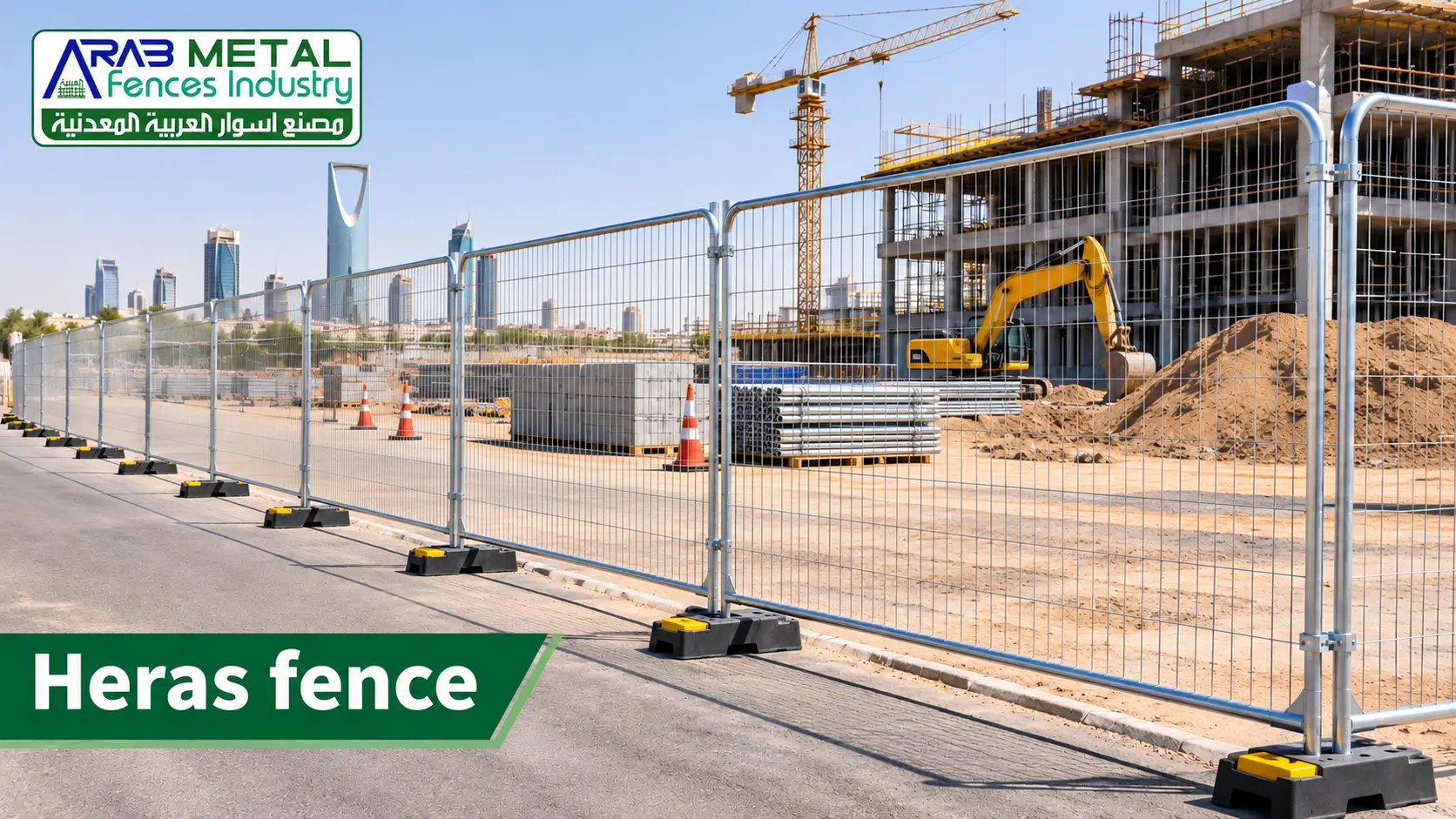
A Heras fence is commonly associated with movable steel mesh fencing used to establish temporary boundaries. Heras is also a registered fencing brand, so genuine Heras products should be distinguished from temporary fencing systems manufactured by other companies.
Arab Fences manufactures its own temporary fencing systems in Saudi Arabia. These products provide practical options for projects that require movable perimeter boundaries and designated access points.
Temporary fencing can support site safety by separating selected activities, identifying restricted areas, and guiding visitors toward approved entrances. However, the fencing system must suit the intended use, site conditions, and relevant safety requirements.
How Does Temporary Fencing Improve Site Organization?
Temporary mesh fencing can help project managers organize different areas of a site without installing a permanent fence.
- Define construction and maintenance boundaries.
- Separate selected work activities from public areas.
- Identify designated entrances and exits.
- Organize access to commercial and industrial projects.
- Establish temporary boundaries around outdoor events.
- Allow perimeter layouts to change as projects develop.
These benefits relate to site organization and boundary management. Ordinary temporary mesh panels should not be treated as certified vehicle impact barriers or specialized crowd-pressure protection systems.
Key Features of Heras Fence and Temporary Mesh Fencing
The effectiveness of a temporary fencing system depends on the complete arrangement rather than the appearance of individual panels.
Important components include galvanized steel frames, welded wire mesh, removable support bases, connecting clamps, braces, and access gates.
Galvanized Steel Frames
Galvanized steel frames form the supporting structure of temporary mesh panels. The zinc coating helps protect steel against corrosion, although actual performance depends on the coating specification and environmental conditions.
Welded Steel Mesh
Welded wire mesh provides a visible physical boundary while allowing air and light to pass through its openings.
Wire diameter and mesh opening size influence the characteristics of each panel. However, these measurements alone do not establish a particular impact resistance or security rating.
Movable Support Bases
Temporary fencing commonly uses concrete or rubber bases to support the steel frames. These components allow compatible panels to be dismantled and relocated when project requirements change.
Connecting Clamps and Braces
Clamps connect adjacent panels, while support braces may be necessary for particular site conditions.
The appropriate components depend on the fence layout, ground conditions, wind exposure, and any materials attached to the mesh.
Heras Fence Visibility and Privacy: What Should You Know?
One important characteristic of temporary welded mesh fencing is its open structure. The spaces between the wires allow visibility through the panels.
This can be useful at construction sites, events, and maintenance areas where teams need to identify boundaries without completely blocking the view.
Does a Heras Fence Provide High Privacy?
Standard temporary mesh fencing does not provide high visual privacy on its own. People and equipment may remain visible through the wire openings.
For projects requiring additional privacy, suitable screening materials or alternative fencing systems may be considered.
Can Privacy Screens Be Added?
Privacy screens and advertising banners may reduce visibility through temporary fence panels. However, adding these materials can change the wind forces acting on the fencing system.
Unlike uncovered mesh, a covered fence may restrict airflow and place additional loads on panels, bases, clamps, and braces.
Before installing privacy screens, the complete support arrangement should be assessed for the intended conditions.
Planning a screened temporary perimeter? Request suitable fencing and support specifications from Arab Fences.
Temporary Mesh Fencing vs. Vehicle Impact Barriers
Temporary mesh fencing can help define access routes and separate selected areas. However, ordinary movable fencing is not designed or verified to provide vehicle impact protection.
The difference between a temporary perimeter fence and a specialized vehicle barrier is important when selecting suitable site safety measures.
| Feature | Temporary Mesh Fence | Vehicle Impact Barrier |
|---|---|---|
| Primary Purpose | Define boundaries and organize access | Resist or manage vehicle impact |
| Typical Components | Mesh panels, bases, clamps and braces | Specialized impact protection system |
| Visibility | Open mesh generally allows visibility | Depends on the barrier design |
| Impact Performance | Not established for ordinary temporary mesh panels | Requires appropriate verified performance |
| Typical Applications | Construction sites, events and temporary boundaries | Locations requiring vehicle impact protection |
Can Temporary Fencing Stop a Moving Vehicle?
Ordinary temporary welded mesh panels should not be assumed capable of stopping a moving vehicle.
Where vehicle intrusion is a foreseeable hazard, a specialist barrier with suitable verified performance should be specified.
Can Temporary Fencing Help Organize Traffic?
Temporary fencing may help identify pedestrian routes, separate selected work areas, and guide people toward designated access points.
However, managing traffic movement is different from providing protection against vehicle collisions.
Temporary Fence Specifications Available from Arab Fences
Arab Fences publishes technical specifications for its locally manufactured temporary fencing systems.
The following table summarizes the main available product options described on the company’s official temporary fence product page.
Temporary Fence Panel Specifications
| Component | Published Specification |
|---|---|
| Standard Panel Size | 2 m high × 3.5 m wide |
| Frame Material | Galvanized steel pipe |
| Frame Pipe Diameter | 33 mm |
| Frame Wall Thickness | 1.5 mm or 1.8 mm |
| Welded Mesh Wire Diameter | 3 mm, 4 mm or 5 mm |
| Mesh Openings | 50 × 100 mm, 50 × 200 mm or 100 × 200 mm |
| Support Bases | Concrete or rubber |
| Panel Connections | Clamps |
| Additional Support | Brace pipes with additional bases |
| Gate Options | Single-leaf and double-leaf configurations |
Technical note: These specifications represent published product options. Exact combinations, availability, and suitability must be confirmed with Arab Fences before ordering.
How to Select the Right Panel Dimensions
The required panel dimensions depend on the site layout, total perimeter length, access points, and intended use.
Arab Fences publishes a standard panel size of 2 m high and 3.5 m wide. Other dimensions should be confirmed directly with the company.
For a detailed comparison, read our guide to temporary fence panel sizes, bases and selection.
Need technical details for your project? Send your required panel dimensions to Arab Fences and request a quotation.
Heras Fence Bases, Couplers and Anti-Lift Connections
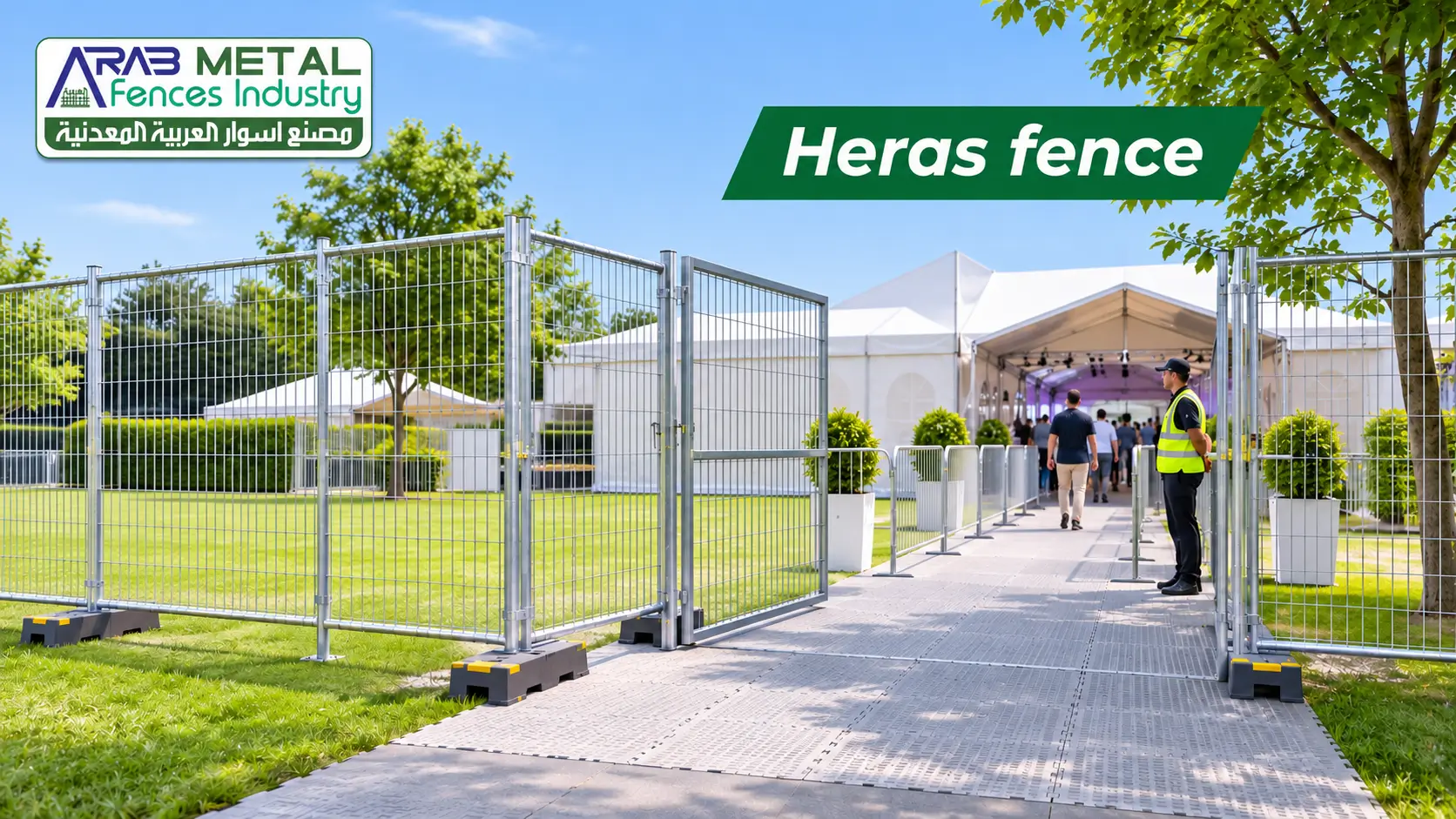
A complete temporary fencing system requires suitable supporting and connecting components. The correct arrangement depends on the selected product and site conditions.
Concrete and Rubber Fence Bases
Arab Fences lists concrete and rubber support bases for temporary mesh panels.
Both types provide removable support. Their suitability depends on their dimensions, weight, geometry, ground conditions, and the complete fence arrangement.
Neither material should automatically be considered more stable for every application.
Connecting Clamps and Couplers
Clamps connect adjacent temporary fence panels to create a continuous boundary.
Missing, damaged, loose, or incompatible connections may affect the intended fencing arrangement. Therefore, the required clamp type and quantity should be included in the project specification.
What Are Anti-Lift Connections?
Anti-lift connections are specialized components designed to make unauthorized lifting or removal of temporary fencing panels more difficult.
They should not be confused with ordinary connecting clamps.
Anti-lift features have not been confirmed as standard components of the published Arab Fences temporary fencing range. Projects requiring these features should request explicit confirmation.
When Are Additional Fence Braces Needed?
Arab Fences publishes brace pipes with additional concrete bases as part of its temporary fencing system.
Bracing may be necessary where wind exposure, attached advertising banners, or other site conditions affect the fence.
The correct support arrangement should be assessed for the specific project rather than applying a universal spacing or bracing rule.
Heras Fence Applications in Saudi Arabia
Temporary mesh fencing can support boundary organization across different types of projects in Saudi Arabia.
However, the selected fencing system must match the intended application and the conditions of the site.
Construction Sites
Construction teams may use temporary fencing to define work areas, separate selected activities, and organize entrances.
Where additional protection against vehicle collisions, falling materials, or other hazards is required, specialist safety measures may also be necessary.
Outdoor Events and Festivals
Temporary fencing may help establish event boundaries, separate service areas, and direct visitors toward designated entrances.
However, ordinary temporary mesh panels should not automatically be considered suitable for resisting significant crowd pressure.
Commercial and Industrial Projects
Commercial and industrial sites may require temporary boundaries during maintenance, renovations, or selected operational activities.
Movable panels can offer flexibility when the required perimeter changes during the project.
Residential and Landscaping Projects
Temporary mesh fencing may be considered during residential renovations, landscaping, and short-term outdoor works.
Its open structure allows visibility, making it different from solid privacy fencing.
For related applications, explore our guide to temporary barrier fencing for outdoor events and construction sites.
Heras Fence Safety Checklist for Sites and Events
Before using temporary fencing, the responsible site team should review the complete arrangement against the approved site plan and relevant safety requirements.
The following checklist highlights important components and conditions to examine.
| Inspection Area | What to Check |
|---|---|
| Fence Panels | Visible damage, deformation and corrosion |
| Support Bases | Condition, positioning and suitability |
| Connecting Clamps | Presence, condition and compatibility |
| Support Braces | Condition and compliance with the specified arrangement |
| Access Gates | Hinges, latches, supports and operation |
| Boundary Layout | Alignment with the approved site plan |
| Ground Conditions | Changes affecting the support arrangement |
| Screens and Banners | Attachments and potential wind loading |
| Public Access | Entrances, exits and required separation |
| Site Changes | New activities or hazards affecting the fence |
Before Construction Work Begins
Check that the fencing layout matches the approved site requirements and that panels, bases, clamps, braces, and gates are suitable for their intended positions.
Before an Outdoor Event Opens
Review access routes, gate operation, panel connections, supporting components, and the expected use of the temporary boundary.
If significant crowd pressure is foreseeable, the selected barrier must be assessed for that purpose.
After Strong Winds or Site Changes
Severe weather, relocated panels, added banners, or damaged components may alter the conditions affecting the fencing system.
The responsible team should reassess the arrangement before continued use.
For additional technical guidance, the UK Health and Safety Executive explains how to select suitable barriers for events. This is general guidance and does not replace applicable Saudi requirements.
Temporary Fence Gates and Access Planning
Access gates allow authorized entry and exit through temporary fencing systems.
Arab Fences publishes single-leaf and double-leaf gate configurations with welded mesh infill.
Single-Leaf Gates
Single-leaf gates may suit openings where one moving gate leaf meets the required access width and operating conditions.
Double-Leaf Gates
Double-leaf gates may be considered for wider access openings, subject to the available design and project requirements.
What Should Be Confirmed Before Ordering?
Specify the number of entrances, required clear opening widths, gate operation, supporting components, and relevant site restrictions.
The final arrangement must also account for applicable emergency access requirements.
Inspection, Maintenance and Reuse of Temporary Fencing
Temporary fencing is designed to be movable, but repeated handling and environmental exposure can affect the condition of individual components.
Inspect Panels Before Reuse
Review steel frames, welded mesh, support bases, clamps, braces, and gates for damage, deformation, significant corrosion, or unsuitable connections.
Damaged components should be assessed and repaired or replaced where necessary.
Reassess Relocated Fencing
A temporary fence configuration suitable for one location may not suit another.
Ground conditions, wind exposure, access requirements, and nearby activities must be considered when the panels are moved.
How Often Should Temporary Fencing Be Inspected?
The inspection frequency depends on the site’s risk assessment, approved procedures, environmental conditions, and intended use.
Additional inspections may be required after severe weather, impacts, damage, or changes to the fence layout.
How to Choose the Right Heras Fence Alternative for Your Project
When comparing temporary mesh fencing systems, consider the complete perimeter requirements rather than selecting panels based on price alone.
Review the intended application, dimensions, supporting bases, clamps, braces, gates, environmental conditions, and expected project duration.
What Affects Temporary Fence Prices in Saudi Arabia?
Temporary fencing prices depend on several factors:
- Panel dimensions: Required height, width and quantity.
- Frame specifications: Steel pipe dimensions and wall thickness.
- Mesh configuration: Wire diameter and opening sizes.
- Support bases: Required type and quantity.
- Connecting accessories: Clamps and compatible components.
- Additional support: Braces and associated bases.
- Access gates: Number, dimensions and configuration.
- Project location: Delivery and site access requirements.
- Additional services: Any separately agreed work or supply scope.
A panel-only price may not include all the accessories needed for the complete fencing system.
What Information Is Needed for a Quotation?
To request a quotation, prepare:
- Project location in Saudi Arabia.
- Total perimeter length or site drawings.
- Required panel dimensions and estimated quantities.
- Preferred frame and mesh specifications.
- Concrete or rubber base requirements.
- Connecting clamps and additional braces.
- Gate quantities and required opening widths.
- Any planned privacy screens or advertising banners.
- Expected project duration and delivery requirements.
Ready to compare temporary fencing solutions? Send your project details to Arab Fences and request a tailored quotation.
Why Choose Arab Fences for Temporary Fencing?
Arab Fences manufactures temporary welded mesh fencing systems in Saudi Arabia and publishes technical information about its product range.
Customers can review documented specifications and components, including:
- Standard temporary fence panel dimensions.
- Galvanized steel frame options.
- Different welded mesh wire diameters and openings.
- Concrete and rubber support bases.
- Connecting clamps and additional braces.
- Single-leaf and double-leaf gate configurations.
These published options help customers prepare clear project specifications and compare the components required for their temporary boundaries.
Exact availability, compatibility, compliance documentation, and commercial terms should be confirmed directly with Arab Fences.
Frequently Asked Questions About Heras Fence
1. What Is a Heras Fence Used For?
Heras is a registered fencing brand, and the term is commonly used in searches about temporary mesh fencing. Such systems help establish movable boundaries around construction sites, events, and other temporary work areas.
2. Does a Heras Fence Provide Privacy?
Standard open mesh fencing allows visibility through the panels and does not provide high privacy on its own. Additional screens may reduce visibility but can increase wind loading.
3. Can Temporary Mesh Fencing Stop a Moving Vehicle?
Ordinary temporary mesh fencing should not be assumed capable of stopping moving vehicles. Vehicle impact protection requires an appropriately specified and verified barrier.
4. What Temporary Fence Panel Sizes Are Available?
Arab Fences publishes a standard temporary panel size of 2 m high and 3.5 m wide. Other dimensions require confirmation.
5. What Is the Difference Between Concrete and Rubber Bases?
Both provide removable support for compatible panels. Their suitability depends on the base specification, complete fencing arrangement, and site conditions.
6. What Are Anti-Lift Fence Connections?
Anti-lift connections are specialized features intended to make unauthorized panel removal more difficult. Their availability within the Arab Fences range has not been confirmed.
7. When Are Additional Fence Braces Required?
Additional braces may be necessary where wind exposure, screens, or banners affect the fence. Requirements depend on the specific site and system configuration.
8. Is Temporary Mesh Fencing Suitable for Outdoor Events?
Temporary mesh fencing may help define event boundaries and organize access. It should not automatically be treated as a certified crowd-pressure barrier.
9. How Often Should Temporary Fencing Be Inspected?
Inspection frequency depends on approved site procedures, risk assessment, and environmental conditions. Extra checks may be needed after severe weather, damage, or layout changes.
10. What Information Is Required for a Temporary Fencing Quote?
Provide the project location, perimeter dimensions, panel specifications, supporting components, gate requirements, and any planned screens or special requirements.
Enhance Site Safety and Security with Suitable Temporary Fencing
Understanding Heras fence applications and the requirements of temporary mesh fencing helps project managers select appropriate boundary solutions.
Movable welded mesh panels can support site organization, define temporary perimeters, and help manage access. However, the complete fencing system must suit its intended use and environmental conditions.
Arab Fences manufactures temporary fencing systems in Saudi Arabia with published options for galvanized mesh panels, bases, clamps, braces, and matching gates.
Contact Arab Fences to Request a Temporary Fencing Quotation and share your project dimensions, technical specifications, and supporting component requirements.