
Looking for temporary fence panels for a construction site, outdoor event, maintenance project, or temporary property boundary? Arab Fences manufactures movable galvanized steel fencing panels with welded mesh infill, compatible bases, clamps, braces, and access gate options for projects in Saudi Arabia.
Choosing the right panels starts with confirming their dimensions, mesh specifications, supporting components, and site conditions. This guide explains the available options, how to compare complete fencing systems, and what to include when requesting a quotation.
Planning a temporary fencing project? Contact Arab Fences for panel specifications and a tailored quotation.
Temporary Fence Panels: Sizes and Available Specifications
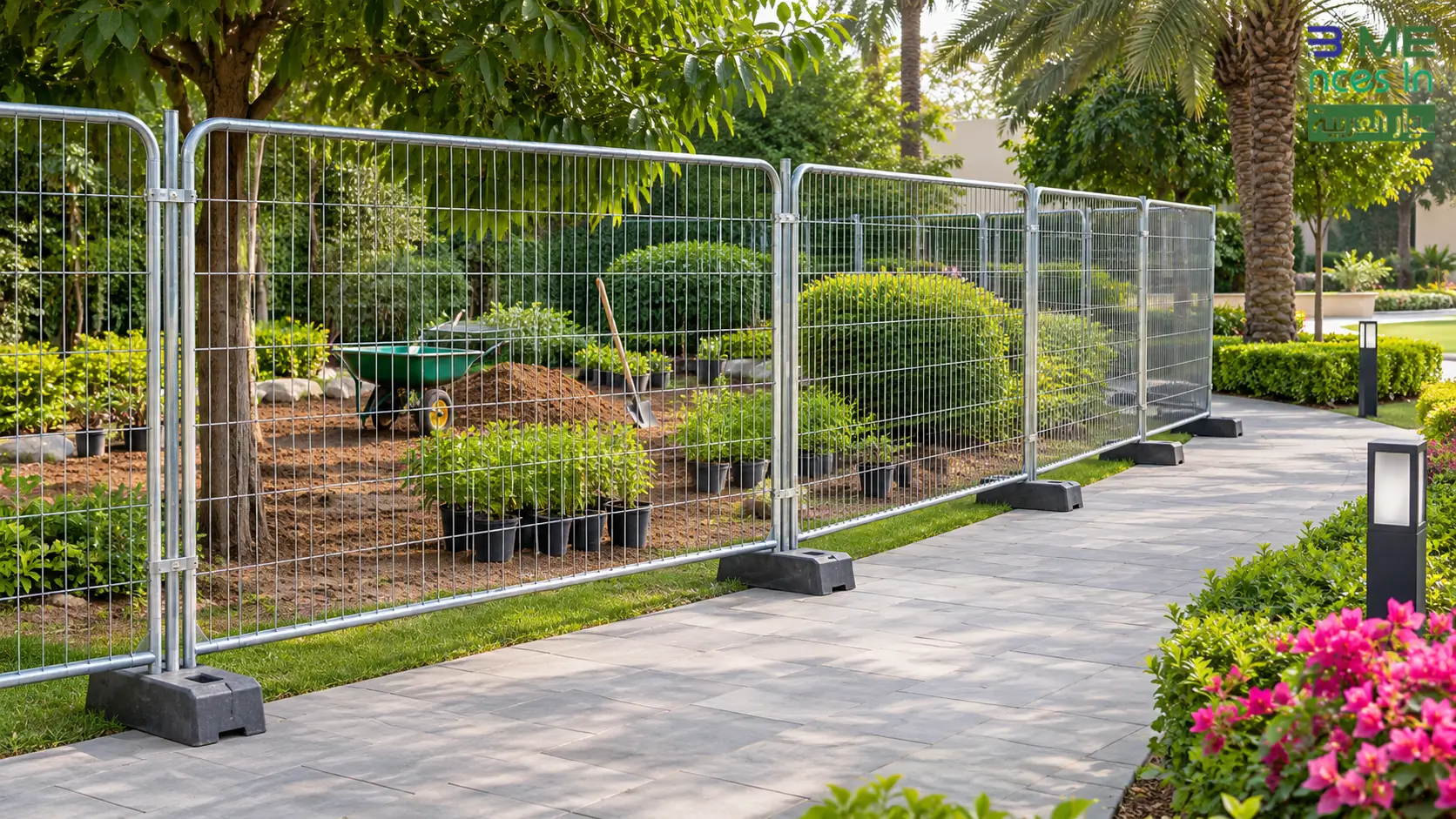
Temporary fence panels are movable steel fencing sections designed to create adaptable boundaries around work areas, events, and other locations requiring temporary access separation.
Unlike permanent fencing, these panels can be disconnected and relocated when project requirements change. However, a complete system must include appropriate connections, supporting bases, and any additional bracing required for the intended conditions.
Arab Fences publishes a standard temporary fence panel size of 2 m in height and 3.5 m in width, along with several frame and welded mesh options.
Temporary Fence Panel Technical Specifications
| Component | Published Specifications |
|---|---|
| Standard Panel Height | 2 m |
| Standard Panel Width | 3.5 m |
| Frame Material | Galvanized steel pipe |
| Frame Pipe Diameter | 33 mm |
| Frame Wall Thickness | 1.5 mm or 1.8 mm |
| Welded Mesh Wire | 3 mm, 4 mm, or 5 mm |
| Mesh Openings | 50 × 100 mm, 50 × 200 mm, or 100 × 200 mm |
| Supporting Bases | Concrete or rubber |
| Panel Connections | Clamps |
| Additional Supports | Brace pipes with additional bases |
| Gate Options | Single-leaf and double-leaf gates |
Technical note: These specifications reflect the published product range. Exact combinations, availability, and compatibility should be confirmed with Arab Fences before ordering.
For further product information, explore the Arab Fences temporary fencing system.
Standard Panel Dimensions
The published standard temporary fence panel measures 2 m high and 3.5 m wide. These nominal dimensions help estimate panel quantities and plan the general boundary layout.
For example, ten panels each measuring 3.5 m wide represent a combined nominal panel width of 35 m. The final layout must still account for actual connections, gates, corners, and other site-specific details.
Alternative dimensions may be discussed according to project requirements. However, a 2 m × 4 m panel should not be treated as a confirmed standard size without technical verification.
Frame and Welded Mesh Options
The temporary fence frame consists of galvanized steel pipe. Arab Fences publishes a standard pipe diameter of 33 mm with wall thickness options of 1.5 mm and 1.8 mm.
The welded mesh infill is available in published wire diameters of 3 mm, 4 mm, and 5 mm, with rectangular mesh openings of 50 × 100 mm, 50 × 200 mm, or 100 × 200 mm.
The appropriate combination depends on the project specification, site conditions, and requirements of the complete fencing system.
Need standard or project-specific panel dimensions? Send your required sizes and quantities to Arab Fences for technical confirmation and a quotation.
Panel Size Checklist: How to Select the Right Temporary Fencing
Choosing temporary fence panels by height and width alone can result in an incomplete specification. Before ordering, consider the layout, site conditions, access arrangements, and expected project duration.
| Selection Factor | What to Check |
|---|---|
| Perimeter Length | Total boundary length and site drawing |
| Panel Dimensions | Required height, width, and available configurations |
| Ground Conditions | Surface type, uneven areas, and base locations |
| Site Layout | Corners, changes in direction, and restricted spaces |
| Access Points | Required gate quantity, width, and operating arrangement |
| Wind Exposure | Exposed locations and any proposed screens or banners |
| Project Duration | Expected period of use and possible relocation |
| Transport | Delivery access, unloading, and storage arrangements |
A straightforward boundary may require a different component arrangement from a project containing multiple corners, access points, or exposed sections.
Sharing a site drawing or bill of quantities helps the supplier review the required panel layout and associated components.
Temporary Fence Bases, Couplers and Bracing Components
A complete temporary fencing system includes more than welded mesh panels. Bases support the frames, clamps connect adjoining panels, and braces may be required for particular site conditions.
The correct arrangement depends on the selected product configuration and the project’s technical requirements.
Concrete vs. Rubber Temporary Fence Bases
Arab Fences publishes concrete and rubber base options for its temporary fence panels. Both are intended to support movable fence sections, but the suitability of a particular base depends on its specification and the overall system.
| Feature | Concrete Fence Base | Rubber Fence Base |
|---|---|---|
| Material | Concrete | Rubber |
| Primary Function | Support temporary fence panels | Support temporary fence panels |
| Mobility | Removable and relocatable | Removable and relocatable |
| Handling | Depends on actual dimensions and weight | Depends on actual dimensions and weight |
| Suitability | Requires project-specific assessment | Requires project-specific assessment |
Neither base type should automatically be described as more stable without comparing its actual weight, dimensions, geometry, and the conditions in which it will be used.
Temporary Fence Couplers and Clamps
Clamps connect adjacent temporary fence panels to create a continuous boundary. Suitable connections help the panels function as part of a complete fencing system.
When requesting a quotation, confirm whether the required clamps and other connection accessories are included in the proposed package.
Temporary Fence Braces and Additional Supports
Arab Fences identifies brace pipes and additional concrete bases as supporting components for conditions such as increased wind exposure or the installation of advertising banners.
Bracing requirements depend on the complete panel arrangement, attachments, ground conditions, and relevant site loads. The appropriate configuration should be determined for the specific project rather than applying a universal brace spacing rule.
Do Temporary Fence Panels Need Ground Anchoring?
Temporary fence panels are commonly supported by movable bases rather than permanent foundations. Arab Fences describes concrete and rubber support bases within its product system.
However, additional restraint or anchoring may be necessary for some projects. The appropriate arrangement must be confirmed according to the site conditions and applicable technical requirements.
For further information about related temporary perimeter systems, read our guide to temporary barrier fences for events and construction sites.
Need panels with compatible bases, clamps, and braces? Request a complete temporary fencing quotation from Arab Fences.
Temporary Fence Gates and Access Planning
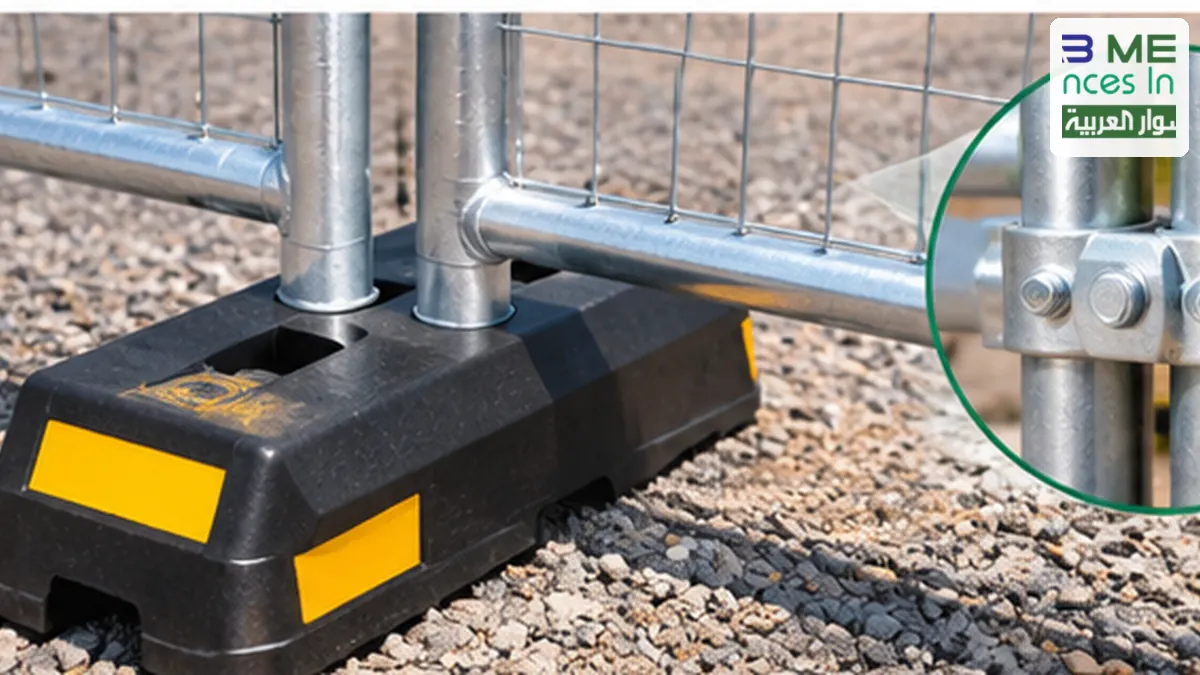
Access arrangements should be considered at the beginning of the temporary fencing project. Gate locations affect the perimeter layout, supporting components, and number of standard panels required.
Arab Fences publishes single-leaf and double-leaf gate options using welded mesh infill designed to complement its temporary fencing range.
Single-Leaf Gates
Single-leaf gates may be suitable for access openings that can be served by one moving gate leaf. The required clear opening width, operation, and supporting structure should be specified.
Double-Leaf Gates
Double-leaf gates may be considered for wider access openings, subject to confirming the available configuration and project requirements.
The company’s product information also refers to swinging and sliding arrangements, but the exact options should be confirmed before ordering.
For either arrangement, provide the number of entrances, required access widths, operating requirements, and any applicable site restrictions.
Where Are Temporary Fence Panels Used?
Temporary fence panels are used across a range of projects where movable boundaries are required. The appropriate system depends on the site’s purpose, environmental conditions, and access requirements.
Construction Sites
Construction projects may use temporary fencing to define work areas, separate selected activities, and establish site boundaries.
Panel layouts should account for pedestrian and vehicle access, changing work zones, and any applicable project safety requirements.
Outdoor Events
Temporary fencing can be considered for defining event boundaries, service areas, and designated access locations.
Event planners must assess the intended use, crowd conditions, and relevant access requirements. Ordinary temporary mesh panels should not automatically be treated as certified crowd-pressure barriers.
Explore our article on Heras fence applications and temporary fencing systems for related information.
Maintenance and Commercial Projects
Maintenance operations and commercial projects may require temporary separation around equipment, outdoor work areas, or restricted sections of a property.
Movable panels can be useful where the required boundary changes during the project, provided the fence is reassessed for each new layout.
Residential and Garden Projects
Temporary fence panels may also be considered for residential renovations, landscaping work, and short-term garden boundaries.
However, open welded mesh does not provide the same visual privacy as solid fencing, and a temporary system is not automatically suitable as a permanent property boundary.
Privacy Screens and Wind Exposure: What Should You Know?
Privacy screens, advertising banners, and other attachments can change the forces acting on temporary fence panels.
An uncovered welded mesh panel allows air to pass through its openings. Covering part or all of that mesh can reduce airflow and increase wind loading on the panels, connections, bases, and braces.
Why Do Screens Affect Temporary Fencing?
Wind-related effects depend on the site’s exposure, the coverage and permeability of the attached material, and the complete support arrangement.
Even a screen described as breathable should not be assumed suitable for every fencing system.
Are Additional Braces Required?
Additional bracing may be required where banners or screens are installed, particularly at exposed sites. Arab Fences identifies brace pipes and additional bases as available support components.
The appropriate arrangement must be reviewed for the specific project rather than relying on general installation assumptions.
For independent technical background, the UK Health and Safety Executive provides guidance on temporary works and foreseeable loads. This guidance is a general technical reference and does not replace applicable Saudi project requirements.
Planning to install privacy screens or banners? Discuss your site exposure and support requirements with Arab Fences before selecting a fencing configuration.
Transport, Storage and Reuse of Temporary Fence Panels
One advantage of movable temporary fencing is the possibility of dismantling and relocating panels as project boundaries change.
However, convenient relocation and successful reuse depend on the condition of the panels and supporting accessories.
Transport and Handling
Transport planning should consider the number and dimensions of panels, total package weight, loading access, unloading requirements, and available storage space.
Handling arrangements should be based on confirmed product specifications and the relevant site procedures.
Storage Between Projects
Panels, clamps, bases, and braces should be stored in suitable conditions and organized so that the necessary components remain available for future use.
Proper organization also makes inspection easier before redeployment.
Inspection Before Reuse
Before reusing temporary fence panels, examine the steel frames, welded mesh, clamps, supporting bases, braces, and gates for damage, deformation, corrosion, or unsuitable connections.
Damaged components should be assessed and repaired or replaced as appropriate.
Reuse is not an unlimited performance guarantee. Each new site arrangement should be evaluated according to its actual conditions.
What Affects Temporary Fence Panel Prices in Saudi Arabia?
Temporary fence panel prices depend on the selected technical specifications, quantities, accessories, and delivery requirements.
A price for the panel alone may not include the components needed to create a complete fencing system.
Main Temporary Fencing Cost Factors
- Panel quantity: The number of units required for the perimeter.
- Panel dimensions: Standard or specially requested sizes.
- Frame specification: Pipe dimensions and wall thickness.
- Welded mesh: Wire diameter and opening size.
- Protective finish: The specified galvanized finish or other confirmed requirements.
- Bases and clamps: Required supporting and connecting components.
- Additional bracing: Support requirements identified for the site.
- Access gates: Number, dimensions, and configuration.
- Delivery scope: Project location, transport, and any agreed additional services.
For meaningful quotations, confirm whether the offer covers panels only, panels with accessories, or a broader supply and service package.
What Information Should You Send for a Quotation?
Prepare the following information before contacting the supplier:
- Project location in Saudi Arabia.
- Total perimeter length or site drawings.
- Required panel dimensions and quantity.
- Preferred frame and welded mesh specifications.
- Concrete or rubber base requirements.
- Clamps and additional bracing requirements.
- Gate quantities and opening widths.
- Details of any privacy screens or advertising banners.
- Expected project duration and delivery requirements.
If some technical details are not yet determined, share the available project information and request clarification on the appropriate product options.
Ready to compare temporary fence panel prices? Send your project requirements to Arab Fences and request a tailored quotation.
Why Consider Arab Fences for Temporary Fence Panels?
Arab Fences manufactures temporary fencing panels in Saudi Arabia and publishes technical information about its standard product configuration and supporting components.
Customers can review documented options before preparing their enquiries, including:
- Standard panel dimensions: A published 2 m × 3.5 m configuration.
- Frame options: Galvanized steel pipes with published wall thickness choices.
- Welded mesh choices: Multiple wire diameters and opening sizes.
- Supporting components: Concrete or rubber bases, connecting clamps, and brace pipes.
- Matching access options: Published single-leaf and double-leaf gate configurations.
- Movable design: Panels intended to be dismantled and repositioned as project requirements change.
These published product characteristics help customers make informed comparisons. Exact availability, compliance documentation, installation scope, and commercial terms should be confirmed directly with the company.
Frequently Asked Questions About Temporary Fence Panels
1. What Is the Standard Temporary Fence Panel Size?
Arab Fences publishes a standard panel measuring 2 m high and 3.5 m wide. Other dimensions require confirmation before ordering.
2. Can I Request Custom Temporary Fence Panel Sizes?
Alternative configurations may be considered based on project requirements. The availability of a specific custom size must be confirmed with Arab Fences.
3. What Mesh Specifications Are Available?
Published welded mesh wire options include 3 mm, 4 mm, and 5 mm, with openings of 50 × 100 mm, 50 × 200 mm, and 100 × 200 mm.
4. What Is the Difference Between Concrete and Rubber Fence Bases?
Both are removable support options. Their suitability depends on the actual base specification, complete fencing arrangement, and site conditions.
5. Do Temporary Fence Panels Need Ground Anchoring?
Arab Fences describes movable concrete and rubber bases. Additional restraint may be necessary depending on the site conditions and applicable technical requirements.
6. When Are Temporary Fence Braces Needed?
Additional braces may be required at exposed locations or when banners and screens are attached. The appropriate arrangement needs a project-specific assessment.
7. Can Privacy Screens Increase Wind Loading?
Yes. Screens can reduce airflow through the mesh and increase wind forces on the fence. Confirm the suitability of the complete system before adding them.
8. Are Temporary Fence Gates Available?
Arab Fences publishes single-leaf and double-leaf gate options. Dimensions, opening arrangements, and compatibility should be confirmed before ordering.
9. Can Temporary Fence Panels Be Reused?
Panels may be dismantled, transported, and reused when their condition and the requirements of the next project allow it. Inspect all components before redeployment.
10. What Details Are Required for a Temporary Fence Panel Quote?
Provide the site location, perimeter length, panel dimensions, required bases, clamps, braces, gates, and any special screening or delivery requirements.
Request a Temporary Fence Panel Quotation from Arab Fences
Choosing temporary fence panels involves comparing the panel dimensions, welded mesh, frame specifications, supporting bases, connections, and access requirements. The right configuration also depends on site conditions, wind exposure, project duration, and potential reuse.
Arab Fences manufactures temporary fencing panels and provides published specifications for compatible components used in construction, event, commercial, and other temporary boundary applications.
Whether you need standard temporary fence panels or want to discuss a project-specific configuration, start by sharing your site dimensions and technical requirements.
Contact Arab Fences to Request a Temporary Fence Panel Quote and send your project location, required panel quantity, perimeter length, mesh specifications, bases, braces, and gate requirements.